
Dead Fish Breathing Lemon Peels
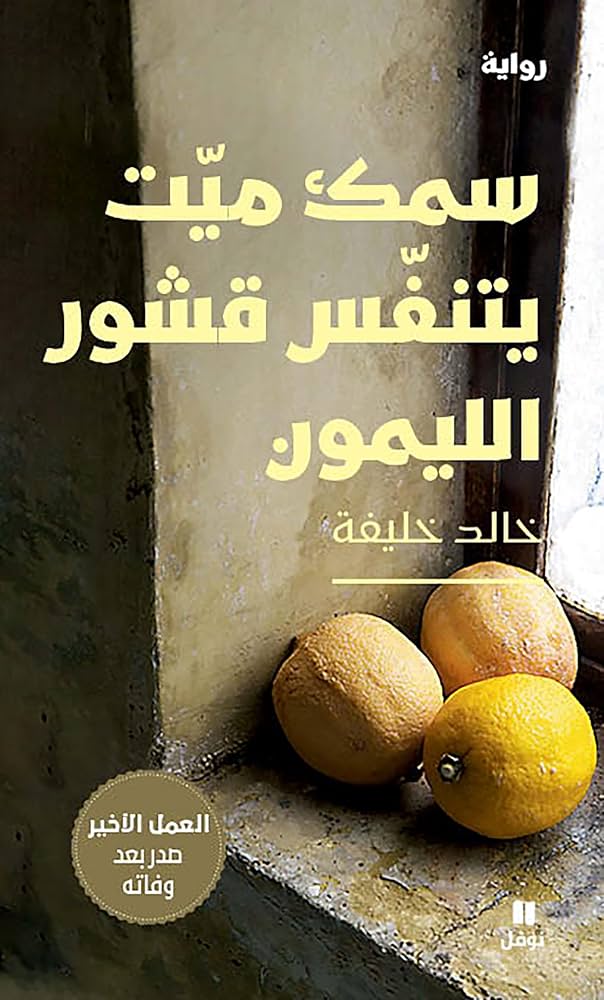
Publication Date: 2024
Publisher: Naufal, Hachette-Antoine
Country of Publication: Lebanon, Beirut
Pages: 263
Samak mayyet yatanaffas qushour al laymoun
Latakia, a Syrian coastal town in the mid-1980s, is the backdrop of this story. A group of friends in their early twenties forms a rock band called The Black Birds. The band experiences one epic success at a concert on the stage of the local church. That performance remains engraved in the memory of the city as well as in the minds of the band members, who felt that night that they were truly musicians, that their music carried meaning, and that they could convey people’s rejection of the city’s transformation and destruction by the local regime. Sadly, the band will never experience another moment of glory, and from that point on, things will deteriorate along with the city.
The novel is structured in four parts, each narrated from the perspective of one of the four main characters. The first part is told by Sam, a brilliant and passionate musician. As the son of a family affiliated with the regime, Sam struggles to remain independent of his cousin’s power and influence. Yet, he ultimately succumbs to this pressure, according to one of his friends, another key member of the band, Musa.
The next part is narrated by Mariana, a free spirit who is madly in love with Sam, and he with her. However, Sam is not exactly the reliable type, and Mariana yearns to escape Syria. She marries the mediocre George and settles into a bland marriage in Boston. Her periodic visits to Latakia reunite her with Sam and reignite their passion—consummated in their friend Anas’s clinic during lunch breaks. With each visit, Mariana bitterly witnesses the band falling apart despite their efforts to revive it.
The third part is told by Musa, the son of an old, powerful, and wealthy family of land and business owners in the region. Musa also struggles to break free from the burdens imposed by his extended family. While he accepts the shops his grandfather gifts him in Latakia’s busiest commercial streets—an acceptance that some of his friends, like Sam, cannot comprehend—he also marries Manal, with whom he falls deeply in love. Manal comes from a different sect and the poorest parts of society. She will never be welcomed by Musa’s family, which ultimately breaks ties with him.
The fourth part is narrated by Manal, the soul of the band, who writes the song lyrics. Manal’s father traffics young girls for temporary marriage, a form of legal, yet socially shunned, prostitution, including his own daughter, Rima. He also becomes a corpse washer in an attempt to salvage his reputation. Manal cleverly escapes her father’s power over her, but suffers from her sister’s fate, and the family’s history. Through language and literature, Manal finds her way to salvation, which crystallizes in her marriage with Musa. But she is never able to completely turn her back to her family. Consumed by guilt, she remains a part of them.
Each part is told in the first person, and presents the most inner thoughts of the protagonist. All of them mention the epic night of the concert, their early lives, their dreams, and their disappointments, mainly with each other and with the place they live in.
“Dead Fish Breathing Lemon Peel” is an ode to youth, an exploration of young people’s dreams, and their fierce determination to pursue them, however absurd and impossible those dreams may seem. It is a coming-of-age novel of sorts, tracing the evolution of these youths into adulthood and the transformation of this group of friends from very different walks of life (and sects), brought together by their love of music and the dream of a free city. Despite their individual efforts to find their place in life away from the constraints of their closed society, they either break or give in, ultimately succumbing to the molds they once rebelled against.
Through their failure to survive as true free spirits, Khalifa depicts the destruction of the coastal town of Latakia, with its seafront agonizing under the relentless work of bulldozers and concrete mixers. By choosing characters from the various main sects and social strata of the city, Khalifa offers a complex portrait of what could have been a rich, vibrant place. With its multiple voices, the novel provides a diversity of perspectives on each of the main characters, illustrating how each one struggles with the dynamics of their family and social environment, thereby cleverly demonstrating how notions like “right” and “wrong” are not always easily applicable to personal choices. From this perspective, “Dead Fish Breathing Lemon Peel” is a modern tragedy, the protagonists of which are trying to fight against their destiny.
Chapter One: Mariana leads her wolf
Sam
Maysoon wasn’t her real name, but it’s what everyone called her. She lay a hand on my arm like she was in a movie, and said, “Even if you were drowning in triviality, you wouldn’t escape.” She paused, and added, “You’re just dogs, all of you.”
At the time, she was trying on some orange high heels in Jazz, a shop halfway along Hanano Street, and reminding Musa of his promise to give her any pair of shoes she wanted. All the while, she kept up a chaotic tangle of words about the man who had left her, after a love story of ten years, to marry her friend. She heaped curses on him in total disregard of the other shoppers who (as is usually the case in such situations) were fully prepared to join in. One woman interrupted Maysoon, wagging a finger at her and declaring, “You’re absolutely right.” Maysoon, however, shut her up with a wave of her hand and the pronouncement, “You’re also a sheep.” A deafening silence rang out over the huge shop; the shoes lined up in the shop window turned into desiccated corpses in the streets of an abandoned city. Musa froze in position like an idol. He mumbled his acquiescence to gift Mariana any shoes she chose and kept his wry gaze fixed on thin air, afraid that the situation would escalate further. He wasn’t able to sympathise with me, or help the other customer who flushed and stormed out without uttering another syllable.
I didn’t know why Maysoon stood directly in front of me and spoke those words with such determination. She added, “Men, in the best of cases, are just shoes you have to throw away after they’ve been used.” I was struck with profound fear at the thought of turning into an old shoe on a garbage heap. It was impossible to enter into debate with a woman who spoke about her own romance with such contempt. I calmly removed her hand from my arm and hurried away; I didn’t care that it would reveal to everyone that I was the man she had been talking about.
After I left (or more accurately fled) the shop, I reflected that everyone who has gone through the act of desertion has learned that the eternal snare of love cannot be dismantled. Many believed that when they turned their backs at the end of a relationship, everything would be finished. These people were wrong.
I recalled the story of Anas Mamoun and his girlfriend, Marwa. After many years of turbulent love, he despaired of ever convincing her to elope with him to Beirut. She always used to say, “I’ll punish them by being a spinster. If I don’t have the right to my own choice of husband, I certainly won’t accept one of theirs.” By them, she meant her family. She was happy to lose her fight against thin air. Anas gave up, and in a moment of recklessness he ended his relationship with Marwa and proposed to Maha Anbary. Maha was also a dentist; they had met in Damascus in 1982 on her first day at the Faculty of Dentistry, just as he was preparing to graduate. The two of them had kept up a collegial relationship interspersed with a few moments of love, and over the eight years they had known one another, they had shared a few brief, lukewarm kisses. Maha had always known about his relationship with Marwa. All the students in the Faculty of Dentistry were aware of the connection between the scrawny boy and the beautiful girl who wasn’t afraid of anything, who lived together in a room of a traditional Arab house in Bab Tuma.
Rowohlt, Germany, German, 2027
Related Articles
Read about this work in the press!

