
Interview conducted by Dimitri Krier, for Le Nouvel Obs, October 16th, 2025
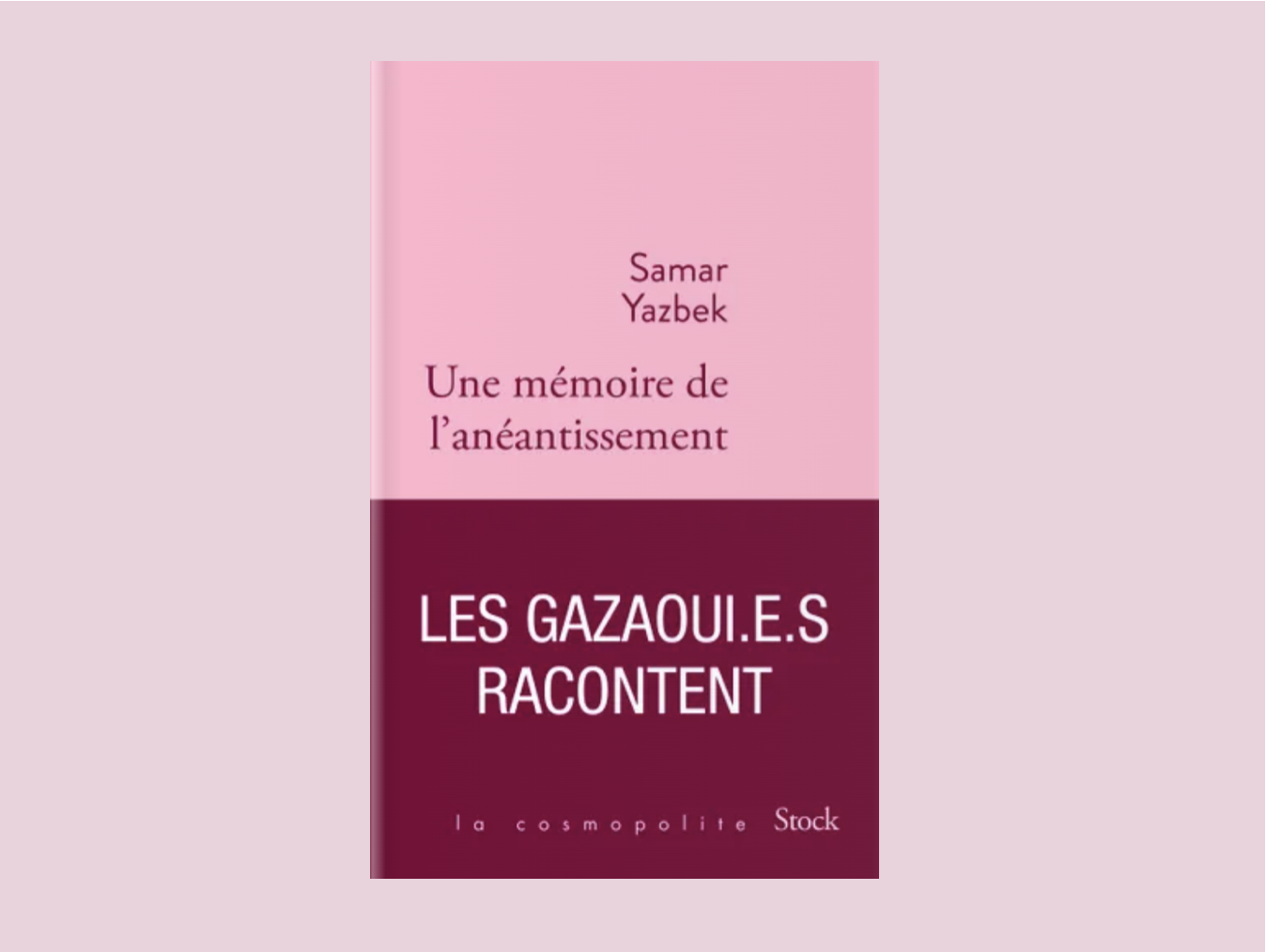
The Syrian novelist and journalist, who published Une mémoire de l’anéantissement, collected testimonies from survivors of the Palestinian enclave being treated in a hospital near Doha, Qatar.
This is the story of a Syrian writer who, in the furnace of the Qatari desert, accidentally discovered the Thumama medical complex. There, just a few kilometers from Doha’s glittering skyscrapers, survivors from the Gaza Strip are clinging to life. Burned, wounded, maimed, they have sad eyes and serious expressions. For nearly four months, Samar Yazbek went to meet them to tell their story.
To all of them, the writer, journalist, and activist asked one question: “What were you doing on October 7, 2023?” Their answers appear in a harrowing, sincere, and intense book: Une mémoire de l’anéantissement (Stock, translated from Arabic by Sarah Rolfo), published on October 8. In this historically significant work, Samar Yazbek brings together 26 chilling first-person accounts from Gazan civilians aged 13 to 65. While passing through Paris, the writer spoke to Le Nouvel Obs about the origins of this project.
What were you doing in Qatar at the beginning of 2024?
Samar Yazbek: I was there for personal reasons. My daughter, who works for the Al-Jazeera television network in Doha, had a serious accident—she fell from a horse. She couldn’t walk for a year. I left France to stay with her in Qatar, at the hospital, where she remained bedridden for several months. Once there, I heard that wounded people from Gaza were being treated at a medical complex not far from Doha, in the desert. I was, at the time, traumatized by my daughter’s accident and preparing for a trip to Sudan to meet women victims of rape. But I ultimately decided to go see them. Very quickly, I understood that as an activist, journalist, and writer, I had to understand their story. I couldn’t leave people in suffering. My tool is words. I wanted to convey theirs—the bodies seriously injured, amputated, or burned. It was as if Gaza had come to me.
How did you manage to convince them to speak to you?
I stayed with them for four months. Every day, I drove an hour to go see them. They were smiling, dignified, as the people of Gaza always are. But most of them were very sad. Their voices were wounded. It wasn’t easy to convince them. I told them I wanted to document their memory.
In your preface, written in September 2024, you use the term genocide. At that time, unlike today, very few people were willing to use that term. Did you hesitate to write it, or was it obvious to you?
I didn’t think about media war or scandalous words. I thought about what I saw, heard, and was told. These are real people, real stories. They are civilians—brothers, mothers, burned children. They are human beings fighting for their lives. I listen to their stories—they are not lying. How can I not believe Abdallah, who saw his mother burn before his eyes? Or the woman hit by a bombing while cooking? Or the son blown apart by a bomb while leaving home to go to school? For the book’s title, we preferred A Memory of Annihilation rather than Genocide. The original Arabic title is The Memory of Loss. It doesn’t mean much in French, but it conveys that feeling when you lose everything: your home, your land, your body…
Following your work as a journalist, you wanted to give women a voice. None directly report having been raped or assaulted, but you write that these are stories you heard. Did you ask them directly?
Yes. They always told me no. I also know that in the Arab world, a raped woman is not considered a victim but a perpetrator. Women in the region face a many-headed monster: patriarchy, traditions, dictators, bombings, radical Islamists. But they remain silent. They refused to speak about this kind of violence. I think they are afraid.
One woman did agree to speak. You cannot reveal her name, so you call her “S.” She describes being forcibly married at 17, then forced to stop her studies. When she was trapped under rubble with her family, she heard her mother call her brothers one by one—but not her, her daughter…
I interviewed about twenty women, but S.’s story really moved me. She is, for me, an example for all women in the Arab world. She managed to summarize, in a few sentences, poetically and with a smile, the problems of Gazan women. In a process of verifying these testimonies, I called several people who knew her. They described a heroine.
You also discuss the different methods used by the Israeli army in this war. You mention the “belt of fire” tactic, which involves subjecting an area to bombardment and crossfire, as well as the use of artificial intelligence, which you describe as the most dangerous tool because it eliminates the instant of hesitation or reflection a human might have before pressing the button… Is this, for you, an unprecedented war?
Yes, it’s unprecedented. If we are capable of killing forty people in a second using algorithms, it’s worrying for the future of humanity. This is not the first time I document war zones, but for me, the war in Gaza is the most dreadful, the most cruel, the most savage. I thought about our future and the role we, as intellectuals, can play in the face of this massacre. [In two years of conflict, according to figures from Gaza authorities corroborated by international organizations, over 67,000 Palestinians have been killed and nearly 170,000 injured, mostly civilians, while the health system and medical infrastructure of the enclave have been destroyed.]
You met young Gazans. One says there are no children left in Gaza. Do you share that impression?
I think he is right. There are no children in Gaza. Childhood has been killed. These children were born into war, into bombings. Even the 13- or 15-year-olds I met are very sad. They carry unimaginable misfortunes. I don’t feel like I am speaking to children or adolescents before me, but to adults. Their eyes, their gaze, their words… Their childhood has been stolen.
Have these testimonies changed your view of Gaza and the Middle East, devastated by this war for two years?
That’s a difficult question. Documenting the region’s miseries has been my work for a long time. I come from a very torn place; I’ve lived with war, with massacres, all the time. Palestine, Lebanon, Syria—they are the same country to me. We cannot give up. We must face suffering and act. I refuse to enter political debates because I know there are victims in every camp. I don’t want to use words that further divide the camps. I am against saying “Jews, Muslims, Christians, Alawites…” Showing part of these people might, one day, be part of justice. We cannot let people die like this. It is my duty to fight the invisibility of victims and injustice. I write for others.
You asked all the Gazans you met one question: “What were you doing on October 7, 2023?” What were you doing that day?
I was in Doha with my daughter. I was shocked and very afraid. I am against violence, and I was obviously against the Hamas attack. But for me, Israel remains a state that colonizes Palestinian lands. I did this work to understand what was happening in Gaza, not to give lessons. I believe I spent enough time with the suffering of others to believe and understand what they tell me.
I also have a question about Syria. Nearly a year after Bashar al-Assad’s fall, do you have hope for your country?
I returned to Syria after Assad’s fall. I stayed several months, in Damascus and Latakia [on Syria’s west coast, an Alawite stronghold]. It is still hell. I fear Syria’s division, I fear that Islamists will control everything, I fear for women, the Alawite communities, the Druze, who still suffer massacres, rapes, and kidnappings every day. These are small communities paying the price for Bashar al-Assad. I had a little hope for Syria last December. Today, I have none.

