
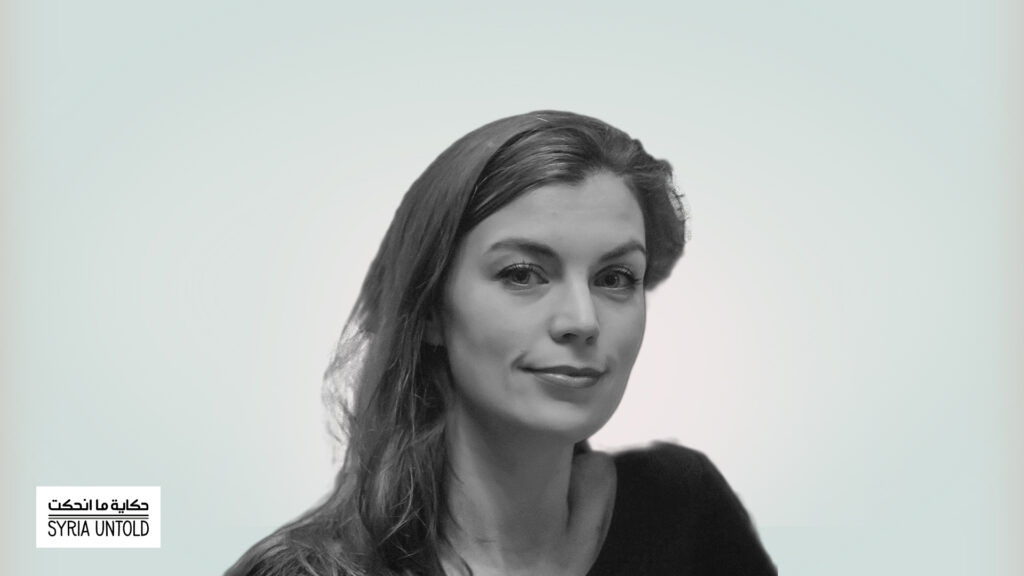
An interview conducted by Tugrul Mende for ArabLit, June 25, 2026
In Your Presence is a Danger to Your Life: Voices from Gaza, Samar Yazbek made it her task to meet with the survivors of an ongoing genocide. While news headlines inform, this book tries to bring forward the human element to the forefront of the genocide. In this book, translated by Leri Price and published by Fitzcarraldo Editions in 2026, readers get a small glimpse of what Palestinians in Gazan have endured in the last three years, alongside a sliver of hope.
Here, Leri Price, who has a long working relationship with Samar Yazbek, talks about the referred trauma (and guilt) of translating testimonies from a genocide, how she worked with translators bringing the book into other languages, and the particular challenges of translating this book.
Tugrul Mende: This isn’t the first work by Samar Yazbek that you’ve translated to English (Where the Wind Calls Home, Planet of Clay). In what way was this book different to work on, for you?
Leri Price: The main difference was that the other works were novels, and this was the first time I had translated anything from Samar’s project of collective memory. This meant that I wasn’t thinking about the text primarily as a work of art, but as a means of conveying the voices it contains. It required different techniques of translation because each testimony has its own inner logic, but that logic isn’t necessarily consistent across the work as a whole in the same way that a novel or even a short-story collection is. Taken together, the testimonies form a new, awful logic, a sort of coherence that arises out of fragmentation.
It was also vital that readers get a sense of the individual giving their testimony. Samar’s literary writing has a very strong and distinctive voice, whereas each of the witnesses had a different voice. Tapping into that was a technical challenge, as well as an emotional one.
Finally, just knowing where these testimonies come from was devastating. I have translated plenty of upsetting scenes in novels which have usually been drawn from real events, but those scenes are part of a structure that also draws in other light and shade. Plus, in a work of fiction, you are more distanced from what you’re writing about. The sheer relentlessness of the testimonies was a new challenge.
TM: In an earlier discussion with Olivia Snaije, Samar talked about how it feels now—at the moment this book is emerging in translation—vs. how it felt when she was putting it together, in the context of the ongoing genocide of Palestinians in Gaza. How have the changing political landscape—and the things that haven’t changed—affected how you approached the book and the testimonies inside? How do you think about the process of shaping their voices in another language?
LP: I don’t think the testimonies themselves have been affected much. They describe the days and weeks following 7 October 2023, and what happened, happened. If anything, the accumulated knowledge we now have of that time (thanks to Gazans themselves) reinforces their truth.
But yes, the translation as a whole has been produced in an increasingly awful context. The past two and a half years have felt like an exploration of just how far political rhetoric will bend in order to accommodate the Israeli government’s derangement. It made the book feel increasingly urgent and necessary as a refutation to the politics that denies Palestinian personhood and enables genocide.
,,,
TM: In the book, you wrote about a few of the difficult translational decisions, for instance about how to render missiles and bombs in English. Were there particular linguistic difficulties that were—if not unique—then particular to this project?
LP: Specific to this book, there was a phrase along the lines of “trapped under the rubble” at least once in every testimony. I wasn’t concerned about the repetition – it is part of the genocide – but I was concerned that if there wasn’t at least minor variation in the phrasing, people would skip over it, or it would lose its impact. The balance between drumming home the relentless nature of the bombings and keeping the language moving was a difficult one to strike.
TM: Certainly for Samar this choice of subject matter, and the way in which she presents it, was a moral act. How do you see your choice to translate it?
LP: Yes, it’s a moral act. I don’t feel capable of very much in the face of such overwhelming horror, but handling these stories with care and respect, being as truthful and as transparent as possible in conveying them to Anglophone readers, is something I can do.
,,,
TM: Fitzcarraldo has brought out several important nonfiction works from Arabic in recent years: Alaa Abdelfattah’s, Bushra al-Maqtari’s, now this. How has it been working on nonfiction; how is your approach different from when you’re working with fictional narratives?
LP: I love Fitzcarraldo’s list and it has been an honor to be published alongside Alaa Abdelfattah and Bushra al-Maqtari. In terms of fiction and nonfiction… there are different kinds of nonfiction of course, so it’s hard to generalize. When I translate literary nonfiction from Samar, I am still aware of it as an artefact and a coherent whole. The testimonies, however, are by nature fragmented, inconsistent, sometimes incoherent. In nonlinear fiction (or nonlinear nonfiction), there is usually an expectation that inconsistencies should be identified and smoothed out, at least for the editorial team – the writer/translator/editor should be clear on what happened when, even if the intent is to disorient the reader. But the testimonies come from traumatized witnesses, and we don’t always know what happened, or where people had perhaps lost their train of thought and mixed up different bombings and massacres. Some of the events remain opaque to us, and the witness’ voice was our guide through this confusion. So, I think the main difference in this instance was the insistence on coming back to the voice itself, keeping the inconsistencies subordinate to the story as it was told to Samar, rather than the other way around.
…

