
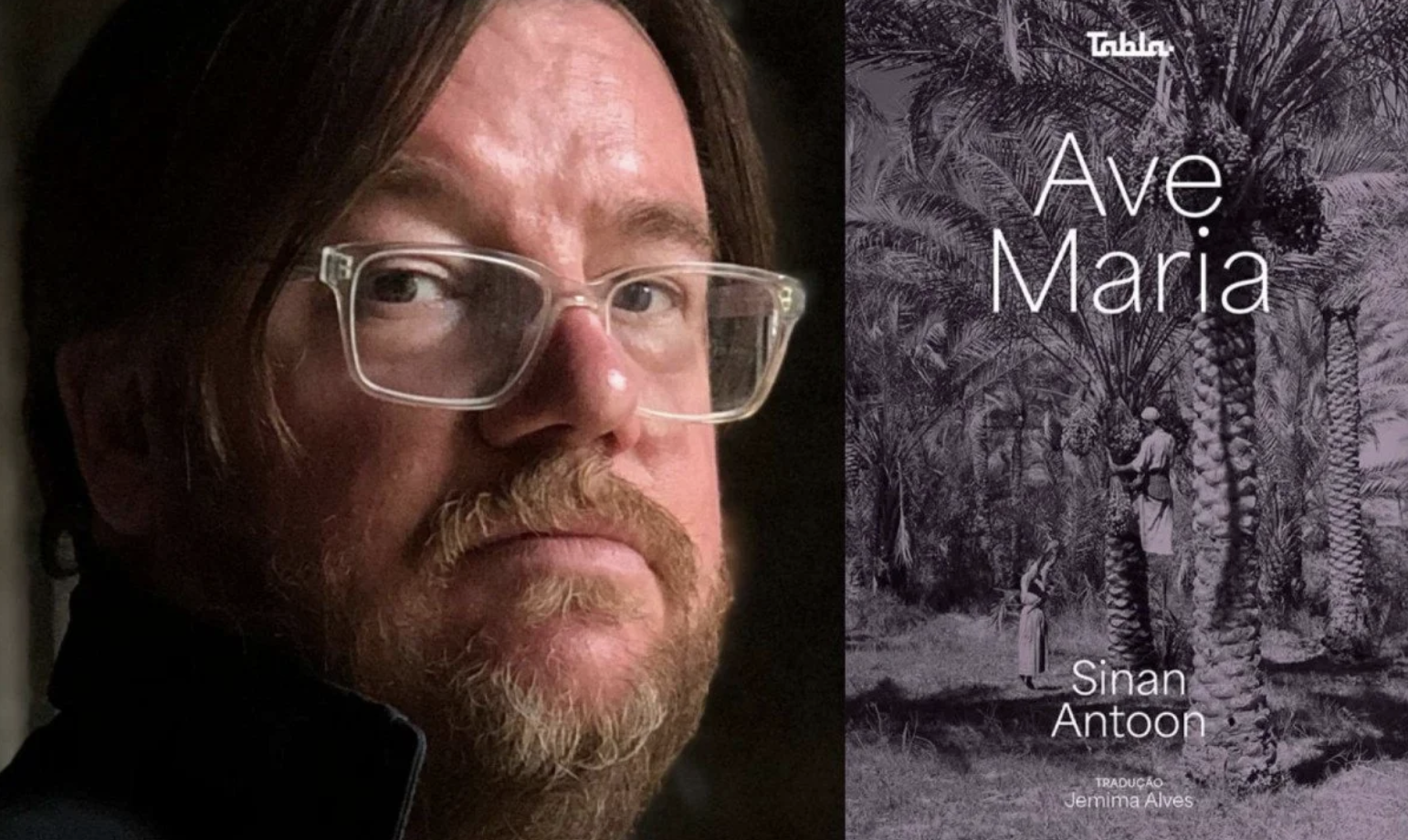
An interview conducted by Eduardo Oliveira for ‘Estado de Minas’, June 5, 2026
The book Ave Maria, by Iraqi writer, poet, translator, and professor at New York University Sinan Antoon, was a finalist for the International Prize for Arabic Fiction in 2013. The narrative takes place over the course of a single day and centers on the elderly Uncle Youssef and his niece Maha. The novel is marked by the pair’s conflicting views, as members of a Chaldean Christian family, regarding the impact of wars and persecution against minorities in Iraq.
The first part of Ave Maria begins with an argument between Youssef and Maha, who accuses her uncle of “living in the past” and becoming trapped in a time when the nation prospered and religious differences were not so evident. The elderly man recounts his story with the help of old photographs, describing a period when “the differences between being a Syriac Catholic or Chaldean, a Sunni or Shiite Muslim, a Jew, an Arab, a Kurd, an Armenian, or a Persian did not stem from religious hatred, but from power politics and competing interests.”
Youssef is portrayed by Sinan Antoon as the roots of a date palm, a tree that symbolizes both the present and the bond with the past. In contrast, Maha sees an Iraq that is fanatical and intolerant, “dominated by a religion spread by the sword.” In the second part of the story, the female protagonist reveals that she is deeply shaped by resentment caused by a great loss. For her, if there is no place for Christians in present-day Iraq, there will be none in the future either. Despite their differences, both seek an opportunity for mutual forgiveness.
Novelist Sinan Antoon was born and raised in Baghdad, where he studied English Literature. In 1991, he sought refuge in the United States because of the Gulf War. He returned to his homeland only 12 years later, after the fall of Saddam Hussein. At that time, Sinan was tired of seeing his country portrayed to the world solely as a place of death, violence, and destruction. He rolled up his sleeves and produced the documentary About Baghdad, which gives voice to ordinary Iraqis. He has also published two poetry collections and five novels.
Read below the interview the writer gave to the newspaper Estado de Minas:
The events described in the novel refer to a terrorist attack that took place at the Church of Sayidat al-Najat in Baghdad in 2010, when dozens of people were killed. Why did you choose this episode, and what inspired the book’s characters?
The reaction of some Iraqi Christians, including members of my own family, was shocking to me because they had been influenced by recent events and had internalized sectarian discourse. I realized there was a kind of collective amnesia, erasing and forgetting a more complex and nuanced history. I remembered a past when being an Iraqi Christian was not a contradiction. I lived in Iraq during the 1970s and 1980s, when class and power were the primary factors, not religion or sect.
The two characters in the novel represent two generations, but also two visions and memories of history and of what it means to be an Iraqi Christian. The dialectical relationship between them shows how war and destruction reshape and distort identities.
Christians have lived in Iraq since the earliest days of Christianity. There were always tensions, of course, but they were never forced to leave the country, nor were their churches attacked, until a few decades ago. This is important because it helps us understand that the roots of these conflicts are not found in religious texts and are neither transhistorical nor eternal. They are rooted in politics and power.
The characters are based on people I knew, especially Youssef. The novel is also a tribute to members of my extended family.
Alongside the protagonists’ personal dramas, readers also follow part of Iraq’s history, including passages about the fall of the monarchy and the period of Saddam Hussein’s rule. What does this book teach us about Iraqi culture, and why?
This is a novel that tells a story, but history is everywhere, and history itself is also a narrative. Characters, events, and plot. The way history is written and read shapes how we see the world and how we respond to events.
Literature plays a very important role in all societies as an alternative memory or a historical counter-narrative, especially in times of war and fascism.
The history of Iraq did not begin in 2003, nor when Saddam came to power. It did not begin with the British occupation either, as some people believe and write. The arrival of colonizers is not the beginning of history.
There is a great deal of history in the novel because Maha and Youssef interpret it differently—and that is not because of religion, but because of ideology. The novel is not intended to teach culture. It is a window into a society with a rich culture, both religious and secular.
The book also highlights the different religions present in Iraq and throughout the Middle East. How are these beliefs rooted in the country, and what contribution have they made to the formation of Iraqi culture?
Iraqi culture is very rich, and the country has been home not only to the three monotheistic religions but also to other faiths and a variety of sects. This may surprise some people because, in the West, our part of the world is often portrayed as monolithic.
In the twentieth century, after independence from British colonial rule, Iraq had a vibrant secular culture. People were proud of their religious and ethnic roots, but there was also an Iraqi identity that included everyone. The founder of the Iraqi Communist Party was Christian, for example. The party’s leaders included Jews and Muslims. Everyone contributed because there was a shared sense of belonging.
Global and regional political changes altered this reality, not only in Iraq but elsewhere as well. During the 1980s, religious identities became increasingly politicized. In Iraq, the U.S. war in 1991, the destruction of the country’s infrastructure, and the sanctions (1990–2003) shattered the social fabric and fragmented society—all under a brutal dictatorship.
The book also highlights the different religions present in Iraq and throughout the Middle East. How are these beliefs rooted in the country, and what contribution have they made to the formation of Iraqi culture?

