
A review by Ibtihal Rida Mahmood for ArabLit, March 17, 2026
…
During her stay in Doha, in the smoldering summer of 2024, Samar Yazbek collected dozens of testimonies narrated by Gazans who, miraculously, had escaped an ongoing genocide, despite their shrunken lives and irreversibly diminished bodies. Yazbek had not arrived in Qatar intending to document Gaza: she had travelled there to care for her daughter after a serious riding accident. But after October 7, 2023, when wounded Gazans began arriving in Doha for treatment, she volunteered at al-Thumama Complex, a site built to host football fans during the 2022 World Cup and then repurposed as an emergency shelter.
“There, survivors of the Gazan genocide were gathered; people with amputated limbs in complex and critical states of health,” writes Yazbek. “Together with the family members caring for them, they numbered more than 2,500.” She recalls how, upon seeing them, she was suddenly struck by a chain of troubling questions:
“Is it even right that we consider them survivors? Where does human pain go when justice is absent?”
Yazbek is no stranger to war journalism. While known primarily as a novelist, she has dedicated much of the last decade to documenting atrocities, particularly in her home country, before any archival dust settled on them. Since 2011, she has written and published multiple books documenting the Syrian tragedy, paying special attention to its effect on the lives of women, in an attempt to secure a spot in humanity’s collective memory: A Woman in the Crossfire (tr. Max Weiss), The Crossing (tr. Nashwa Nasreldin and Ruth Ahmedzai Kemp), and 19 Women.
When she began collecting testimonies for her book on Gaza, she initially planned to “focus solely on women, but with time, and after seeing the numbers of children and teenagers, I decided to meet with as many people as possible and to make a selection.”
Still, in her conversations with women, she noticed something. “Women would tell me about rape and harassment that had happened to other women.” By contrast, “when it came to their own experiences, the women would deny having been personally subject to any such abuse.” Yazbek attributes the women’s reserve to social surveillance in Gaza’s conservative society. But it is also important to note how this is another example of the double-bind in which colonized indigenous women often find themselves, as they face colonial gendered violence that weaponizes their bodies and the prevalent patriarchy in their own society. It would be impossible to imagine a raped Palestinian woman reporting on her sexual abuse to the authorities actively engaged in annihilating her family – and herself.
Speaking to the Gazan survivors in Doha, Yazbek almost instantly noticed a pattern. “Those phantoms embodied a recurring symbol of humanity’s defeat, as if Palestinians had become Syrians and Syrians Palestinians, across a shared space of brutality that I have witnessed, written about and buried in my heart.”
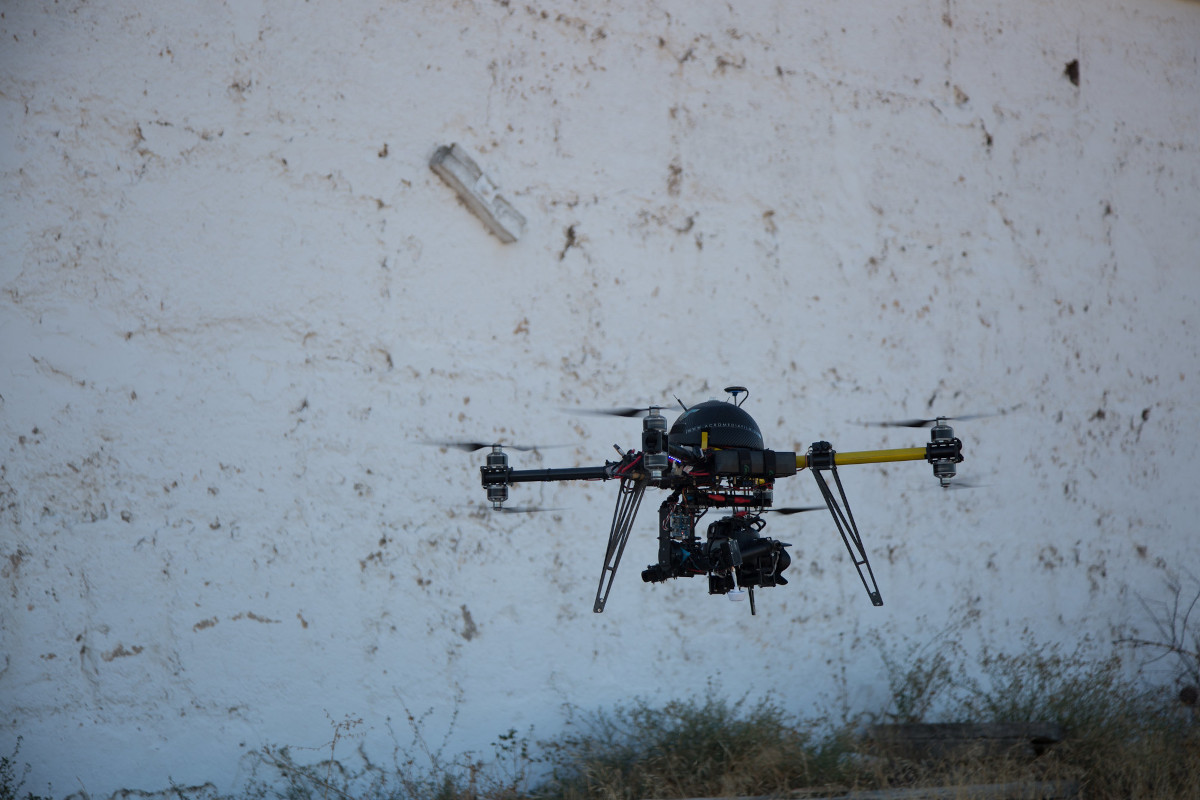
Yet despite the many similarities, Yazbek points out one “novel detail” that stood out to her in the testimonies, one that she never encountered throughout her work in the Syrian context. Namely, it was “the unleashing of algorithms of murder, the use of artificial intelligence to kill,” in the form of what Gazans described as zannanat (drones) and quadcopters, able to “enter houses, bedrooms, stop over children’s heads, issue instructions, shoot in the head, take iris scans, shoot in the eye, accompany the lines of those who are displaced and escaping bombardment and forced to leave their homes, remaining above their heads to compel them to flee.”
Horrific as it is, the need for a human to decide who should die when, where, and how—a human with all their complexities, hesitations, and conflicting moral values—can now be removed altogether from the murder equation. “Palestinians have become merely undesirable data,” Yazbek concludes, and, in this moment, she alerts us to the bleak future that awaits, now that this has been allowed to happen in the open-air prison of Gaza.
The testimonies further corroborate what international organizations have been reporting for more than two years on AI-assisted targeting in Gaza. One harrowing account comes from 22-year-old Shaimaa Naji, who narrates her encounter with one of those killing machines on October 22, 2023.
“[I] went out onto the balcony to get some fresh air, only to be surprised to find a zannana right in front of me. It was watching us. At first I thought that it was a missile fired remotely and it occurred to me to take a picture, but I suddenly noticed it was a reconnaissance drone, and it had in fact been taking pictures of us. I hurried back inside, heavy-hearted. Before long, we heard it shoot. We realized later that it was scoping the place out. My father was a target. These drones, quadcopters, can shoot or detonate themselves. As if murdering in person isn’t enough, they’ve brought us mechanical murder in the form of drones.”
One of the most devastating descriptions in the book comes from Abdullah Yousef Aakila, a 13-year-old boy who watched his mother burn in front of him, during what was supposed to be a civilian evacuation on an UNRWA bus in December 2023.
“Why did the zannanat bomb the bus again?” he still wonders.
“I saw my mother on fire with my own eyes. I tried to save her, but the electric door wouldn’t open. The driver escaped and I wasn’t able to open the door. My uncle threw his son out of the window, and I survived because my uncle eventually managed to get the door open, but the missile had fallen right on my mother and my sister and they burned, they were in the part where the missile landed.”
….
While narrating death and destruction, the witnesses Yazbek spoke with still found a way to illustrate that, in the words of Palestinian poet Rafeef Ziadah, they taught life. Many insisted on showing Yazbek pictures of their families and of themselves when their bodies were still whole; some entrusted her with a list of names of the people they lost; they defied erasure by every means available to them.
Each of these 27 testimonies, even those by younger witnesses who have lived their entire lives under siege and consecutive Israeli military assaults, is further proof the people of Gaza want to live—a shocking statement to a world so accustomed to the dominant Israeli narrative, which claims that Gaza fosters a culture of death. If anything, the testimonies illustrate beyond doubt that death and destruction are, and always have been, imposed on Gazans by a world that seeks to dehumanize them in every way imaginable.
“We have lived under siege for a quarter of a century… We were carrying on as if we were going to live forever, but we knew we might die at any moment… We are human and we want to live, we have children and we want them to live.”
….
first read the book in its original Arabic, when it bore the searing title ذاكرة النقصان (A Memory of Diminishment), a phrase that evokes erosion of bodies, homes, even life itself. Only afterward did I turn to the English edition, where Leri Price’s translation carries the weight of and preserves the full force of the testimonies. Reading the two versions in sequence made the precision of Price’s work unmistakable.
The book begins with two introductions: one that accompanied the Arabic edition, written in September 2024, and a second written in November 2025 in preparation for the release of the English edition. Between the two intros, one can trace a shift in Yazbek’s approach, from “venerating the personal and the subjective” to the pursuit of an answer to a question that originated in bell hooks’ view that the personal is political: “Was I right to record these testimonies?” There’s a change in Yazbek’s authorial mood, from careful hope to disappointment, moving from “we must rebuild the world with words, so that perhaps one day, the justice that has been so ardently pursued can finally be realized” to a bleaker, disillusioned tone, after seeing how a livestreamed genocide for two years and counting has been met with virtually no accountability: “perhaps I have done nothing but add a black stain to human history. A stain of words… the words of the people of Gaza.”
However, Yazbek’s collection of testimonies, spanning the shattered lives of children as young as thirteen to the weary wisdom of the elderly, refutes the diminishment intended by the airdropped leaflets. If the leaflets claim their presence is a danger, Yazbek proves their erasure is the true catastrophe.

