
A review by Yağmur Dinç for Sabit Fikir
In A sleepless giraffe in Damascus although the “giraffe” character is seen by some readers as a symbol of the Syrian revolution, Khalil Alrez states in an interview about the work that this was not his intention. Clearly, the insects on its bright, wide, and beautifully spotted skin; its stillborn calf that fell from its lofty womb; the songs it murmurs at night accompanied by wheezing sounds from its long neck; the bond it painstakingly forms by bending down to a camel bird—all of these seem to lean only toward the reader’s allegorical interpretation. In the imaginary neighborhood of a Russian woman who has set her sights on the Mediterranean, in Damascus, I don’t think there is room for such contradictions.
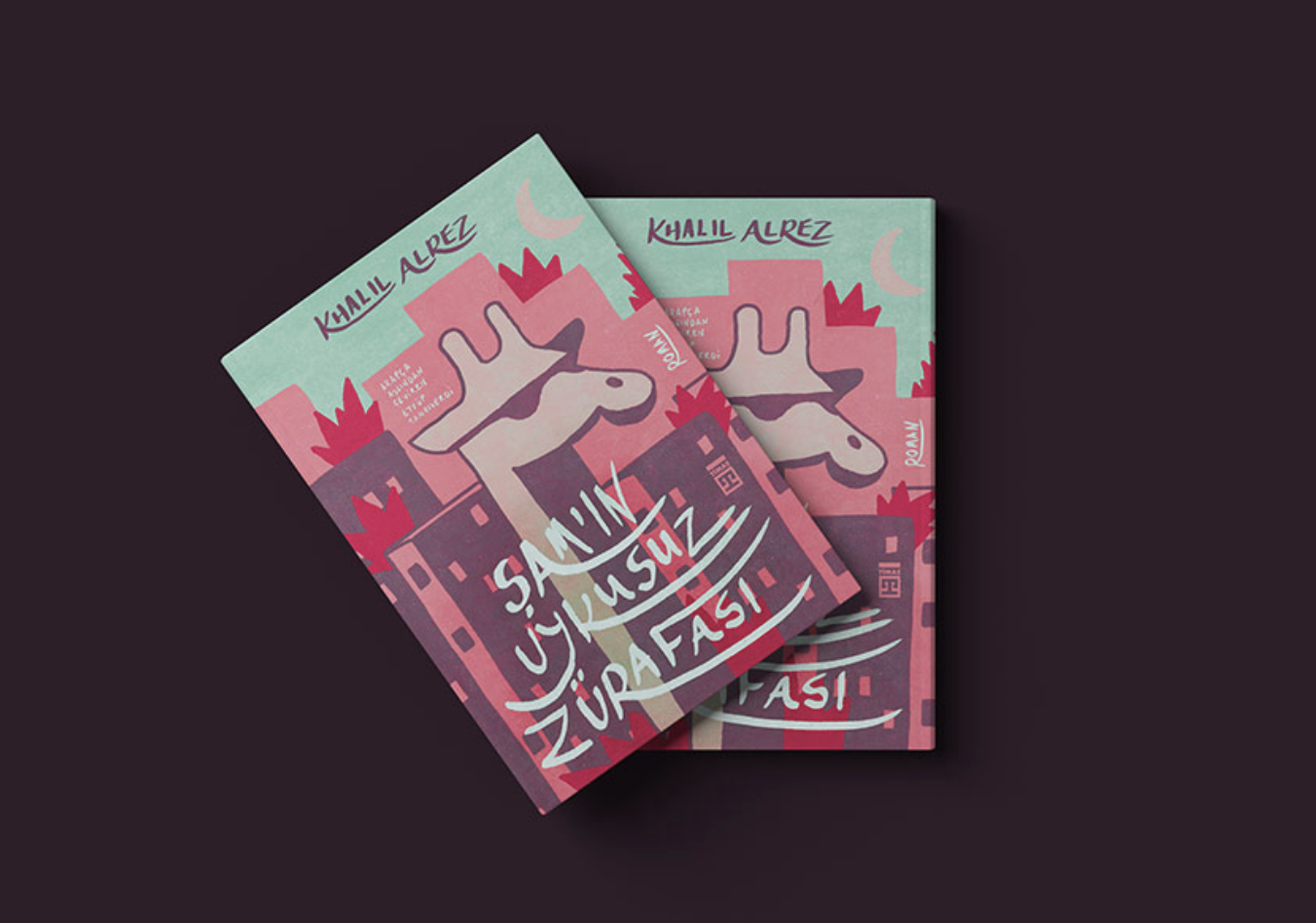
Meeting Khalil Alrez for the first time in Turkish happens through A sleepless giraffe in Damascus. Recently translated into our language by Eyyüp Tanrıverdi and published by Timaş Publishing, the novel manages, at first glance, to capture the curiosity of literature lovers with its subject and content. Such a gain may require the reader to maintain their attention; indeed, the novel seems to tie its clarity and comprehensibility to the reader’s patience in the opening pages.
Of course, we cannot overlook the contribution of encountering the language of a Syrian writer for the first time in Turkish. Even if it is somewhat challenging, once we pass this stage, we also come face to face with the expressive power of Arabic literature. Alongside novel writing, we should also acknowledge the theatrical tone that dominates the work of a writer who is also involved in theater and playwriting.
Through the novel, we also witness one aspect of Khalil Alrez’s connection with Russia. After studying Arabic Language and Literature in Aleppo, he went to Moscow in 1984, learned Russian, and worked in Arabic departments of local publishing houses in the country. Having lived in Russia for 10 years before returning to Syria in 1993, the author considers Russia an integral part of his cultural background and sees himself as a hybrid individual; he also gives place to his life in Russia in his previous novels: The Substitutes, The Giraffe, and The Poppy. It seems that becoming familiar with cultural references and the relationships between characters will be even more possible as his works are translated into our language over time.
A Russian Neighborhood in Damascus
We observe the same motifs in A Sleepless Giraffe in Damascus. In the novel, a long-standing war that has engulfed everything is resisted, yet ultimately, we find ourselves among the residents of an imagined neighborhood. This is a Russian district; not one entered by weapons of war, but by dreams. Although some readers see the “giraffe” character in the novel as a symbol of the Syrian revolution, Khalil Alrez, in a remark about his work, says he did not intend this. Certain bright, wide, and spotted beautiful skin insects, its young that fell from its high womb, the lullabies whispered as it sways its long neck through the night, and the bond it builds with the camel it leans on with great effort—all relate only to the allegorical perception of the reader. In this dreamlike Russian corner of Damascus, I think such contradictions do not exist. It is worth emphasizing that the author, who chooses some of his characters from animals, avoids comparing them to other literary texts. As he himself states, President Petrova is only an Afghan dog, Mostas is simply an ordinary dog, Gazale is just a domestic cat; yet we should imagine that once a work of art is completed, the creator accepts that it forms a ground for interpretation by its audience.
A rich narrative feast
Throughout the novel, the protagonist is referred to only as “the narrator.” “As if higher than other living beings, he had developed an innate capacity for compassion and love toward all of them,” he says about the giraffe, and the story begins between the giraffe—whose magnificence he cannot resist—and Nonna, who responds with a soft heart. The diversity of characters accelerates the narrative and continues through a series of events.
The zoo director Victor Ivanic, the French teacher Fransizca, the tradesman Abu Ali Suleyman, the neighborhood hero Isam, the well-known Russian writer Arkadi Kozmic, and many others draw us into this rich storytelling feast. In this multiplicity, rather than forcing the reader’s attention, the author leaves us with a pleasurable understanding shaped by his mastery in connecting people and events. In Sam’s Sleepless Giraffe, this is perhaps one of the most admirable aspects: the plot and the style.
Between dream and reality
In Sam’s Sleepless Giraffe, the first element that keeps us within the story is the metaphor of “blindness.” The narrator, who tries to attract the giraffe’s attention with forest documentaries on thirty-five television channels, and Nonna’s perception are shaken by the information given by Victor Ivanic: the animal has gone blind due to an illness and has been abandoned in this garden by the circus.
This shock quickly settles, because according to sincere, valuable, and experienced reasoning, the giraffe is not blind. As we delve deeper into the subject, we get to know the narrator’s mother better—someone who searches, investigates, and finds everything with her hands and heart.
In these parts of the novel, Alrez almost redefines simplicity with a closed narrative style. The neighborhood, which managed to protect itself during the war, eventually becomes exposed to this terrifying destruction, and the continuity of events flows beneath the bridge Alrez builds between dream and reality. The language and wordless communication between characters throughout the novel is another nuance that enhances the book’s quality. “I am not writing a historical novel, I am writing a novel,” says the author—one we encounter in Turkish for the first time—and we come to appreciate a different kind of “magical realism.”

