
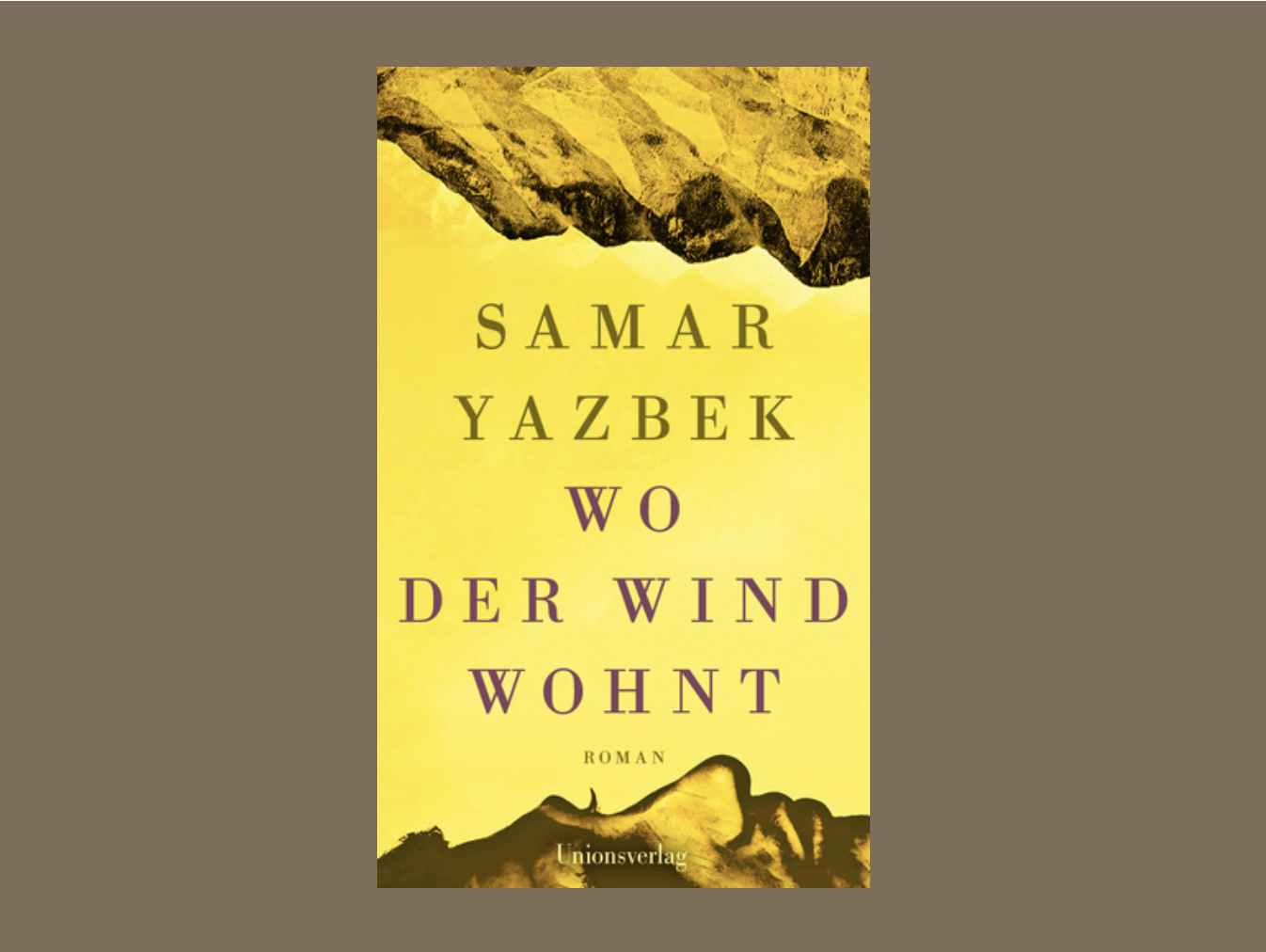
A review by Stephanie von Oppen for Deutschlandfunk Kultur, Studio, March 8, 2026
At least 70,000 dead and 170,700 wounded in Gaza. Behind each number lie countless individual fates. Samar Yazbek spent three months speaking with survivors in a rehabilitation center in Qatar. 27 personal, often harrowing stories are gathered in her book.
It is a powerful image that Yazbek paints in her introduction: she is on her way in blistering heat to the Al Thumama complex — a group of buildings originally built for participants of the FIFA World Cup in Qatar. Today the complex serves as a rehabilitation center for severely injured people from Gaza and their relatives.
Yazbek sees “black shadows” approaching her, “strangely moving phantom figures.” Then she recognizes the shadows as people in wheelchairs with missing limbs. This reminds her of images from her own destroyed homeland of Syria: “the same appearance of the victims and the same moaning.”
Samar Yazbek is best known for her documentary book about the revolution in “In the crossfire”. Because she ended up on the death lists of the Assad regime, she fled to Paris with her daughter. When Yazbek conducted her interviews in Doha between March and June 2024, there were about 2,500 people there — and the war in Gaza would continue for more than another year. She spent almost four months with war invalids, speaking again and again with them and slowly gaining their trust.
She interviewed people from very different walks of life — mostly women but also men, children, and adolescents. They come from different social backgrounds: some worked on a chicken farm, others as nurses or doctors. They are teachers, professors, accountants, and students. They lived in apartments or houses with gardens. Some had just married when the war broke out, were pregnant, or already had large families.
All have been through hell, all have lost family members — their own children, their parents. Fingers, hands, feet, arms, legs were torn off or destroyed by bombs and drones. Some lay for hours under rubble. One man was already in a body bag when he managed to make a sound at the last moment. These severely injured people managed to survive — under unimaginable conditions. Some describe how maggots grow in their poorly treated wounds.
Many tell of the leaflets with which the Israeli army warned of the next bombing. They proved worthless — because far too little time was given to them. Eventually, they didn’t even know where to go.
After so many wars, this one was like “Judgment Day” — with all the brutality of modern warfare: drones and so‑called quadcopters that remotely chase civilians, or “fire belts,” especially heavy rocket attacks.
There are massacres and severe mistreatment, including serious injury by the Israeli army. Hamas is almost unmentioned. That is a strange blank, and it remains open how the interviewees view Hamas’s role. Yazbek emphasizes that she deliberately avoided political questions — she wanted to document only subjective experiences.
Thus the people also speak of their life dreams. A boy, for example, thinks of his crayons and his drawings, all now burned, and hopes that one day he can paint again.
These eyewitness accounts are written without hate, without anger, without a desire for revenge. Rather, there is a disbelieving despair inherent in these texts. The people remember good times in Gaza, in their homeland.
“Gaza” brings into view the situation of Palestinians in the conflict zone — without diminishing the horror of October 7 and the brutality of Hamas: serious war crimes by the Israeli army become apparent. Yet, despite all the horror, this is above all a book about humanity — about people who, despite their immense suffering, fight for their own lives and those of others and even preserve a piece of hope. Making their voices public gives these Palestinians back a piece of dignity.

