
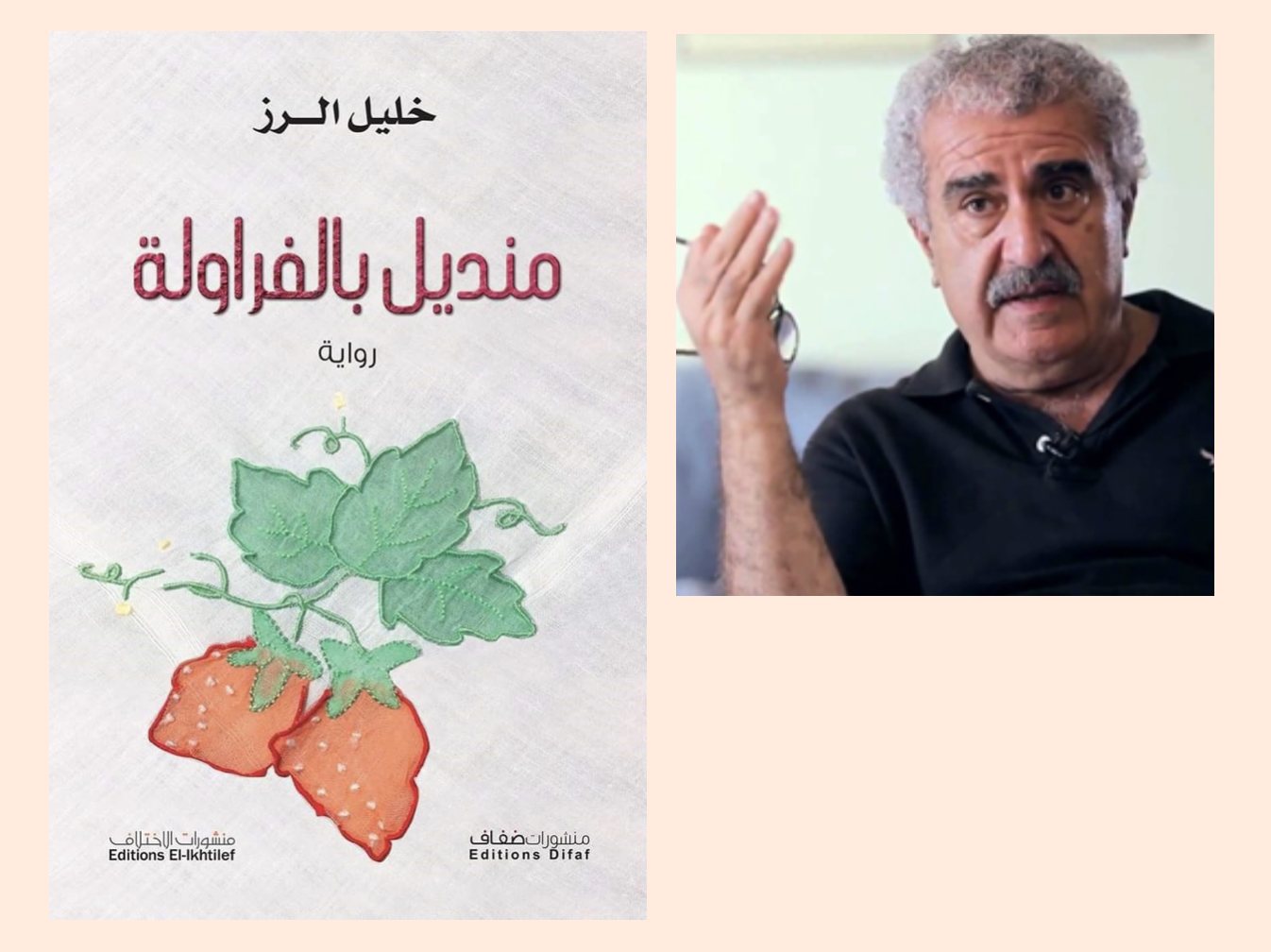
A review by Hassan Daoud for ItaliaTelegraph, September 15th, 2022
Because he tells his own story, this man remains without a name. Those he loves and befriends are introduced by their names (Raya, Nonna, Salem, Maxim Vadimovich, and others) before their presence is even felt. Never, throughout the pages of the novel, does anyone address him by name, nor does he—who holds the reins of the narrative—declare a name for himself. I once thought this was due to the author’s delay, as if he had only realized by page thirty that he had failed to name his hero and could no longer correct the oversight. But the name Franz Kafka gave to the hero of The Trial—the single letter “K”—suggests that one should be wary of what names confer upon those to whom they are attached.
Thus, the hero of “Strawberry-spotted handkerchief” remains nameless yet he begins to reveal his inner world from his very first adventure, saying that he prefers absence and oblivion to being present among others, and that he is an expert at this. For example, while sitting in his office listening to a colleague speak, he is able to arrive in advance of his beloved, the Azerbaijani Raya, to the capital of her country, Baku. Indeed, he can precede her several times over, each time aboard a different train—riding numerous trains departing simultaneously from Moscow, Leningrad, Riga, Vilnius, Kyiv, Kharkov, Tashkent, and the other capitals of the Soviet Union, to which the novel returns in time. He would arrive at Baku’s railway station at closely spaced intervals, inventing for himself, each time he disembarked, a different excuse for not accompanying her on her journey, or reasons related to the troubles he had encountered on each of these many trips.
Khalil al-Rez, the novelist, can pursue his associations about his hero—indeed, his deliriums about him—without end. In one scene he lets him give free rein to his fantasies while speaking to Raya on the telephone: he imagines that, although she is thousands of kilometers away, she can discern the bluish bruise in his eye, the one caused by a punch he received in a nightclub, where he had been in the company of another girl. Raya can even tell, from that same distance, whether he is holding in his hand the doll he brought with him for that purpose. What Khalil al-Rez truly achieves is to let his imagination run unimpeded, to allow his writing to flow and pursue itself, recalling what one writer once said about the overwhelming sense of freedom that accompanies moments of rich, surging creative flow.
Although the author goes far in analyzing the uniqueness of his hero, he never loses the comic—indeed, the farcical—tone that colors every romantic or non-romantic situation. The flashes we read, which deeply reveal the personality of that man (the hero), become the very material of a humor in which the novel itself does not hesitate to indulge. It is as though we are reading chapters of satire directed at the seriousness that has accompanied literary writing throughout its history. A single scene in Strawberry-spotted handkerchief is half romantic and half ironic, or half tragic and half comic. All the characters are divided between these two halves. We might recall here the last chapter of the novel, in which he celebrates the birthday of his new—and final—beloved, Nonna. The novel thus unites two impulses: it insists that we continue reading it, as suspense novels do, while constructing everything we read upon an ironic and satirical weave.
Hence it seems acceptable—indeed, arising from the very narrative context—that the narrator, recalling his years of life in Moscow in the 1960s, should appear almost like an aesthetic and visual art critic when distinguishing the striking differences between Kufic script and Thuluth script. We read this as we would a critical essay. The same is true of other matters, such as the shifting meaning of the strawberry throughout history and literature, from ancient Greece to Shakespeare’s Othello, where in old illustrations the strawberry symbolized purity and chastity in love, before later becoming a symbol of lustful and licentious love. This historical approach is interwoven with the most farcical, surreal, and at the same time sexual scenes of the novel, when our man—the narrator and hero at once—witnesses Volodya immersing the feet of his beloved Nonna in a basin filled with strawberries, recalling that earlier peoples used to make wine from this fruit in precisely this way.
After his novel The Russian Quarter, previously reviewed on these pages, Khalil al-Rez reveals to us his powerful and creative talent for blending imagination with reality and for marrying the possible with the impossible. Once again, he brings us back to his gift for storytelling—the kind that makes you, even while busy with other work, find yourself thinking about the folded-up pages where you left off, longing to return to them as soon as possible.

