
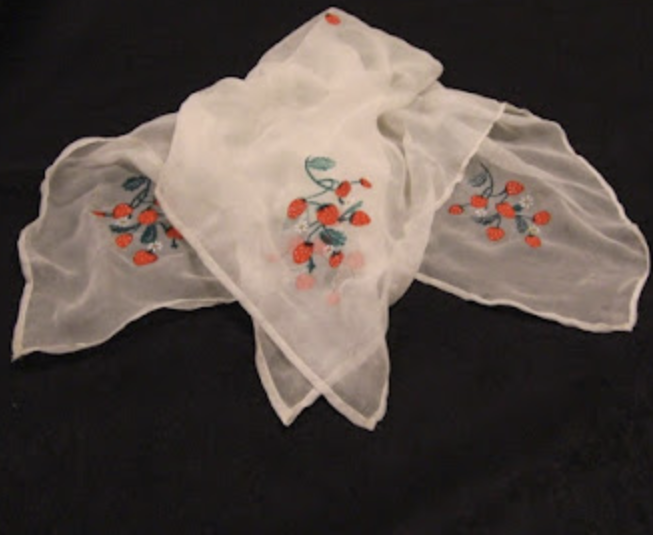
A review by Ezzat Omar for Al-Arab, June 28th, 2022
Several Arab novelists have gone beyond the classical structures familiar in their works, and some have boldly ventured into experimental realms using multiple techniques, generating distinct aesthetic and intellectual stakes. The Syrian writer Khalil el-Rezz, in his latest novel Strawberry-spotted handkerchief, is one of these writers, having distilled decades of his narrative experience to present his readers with a work that is distinct within the Arabic literary landscape.
El-Rez’s Strawberry-spotted handkerchief presents a narrative system anchored by a narrator closely identified with his story (speaking in the first person), a central character from whose perspective the events unfold according to a supposition posed by the narrative moment. This supposition requires imagining a story whose events have not actually occurred, which the narrator—let us call him “the writer”—composes in real time as the events play out before the reader in an engaging and convincing manner, making the reader forget that this is a grand act of imagination, one in which the narrator travels into the realms of fictional imagination pioneered by the great Surrealists, especially in their artistic and poetic works.
In other words, the story—including the conflicts between its characters—is plausible within the narrator’s imagined framework. In approaching this, I found it necessary to compare it with the “Underground Man,” the central character in Dostoevsky’s Notes from Underground, with the main difference lying in the narrative approach of each narrator.
Where the task of the “Underground Man” is to reveal the relationship of the marginalized individual with a society structured on rigid class hierarchies in the nineteenth century, the narrator in A Handkerchief with Strawberries is a writer living introvertedly, experiencing alienation and anxiety that drive him to continuously compose and narrate successive stories. These stories are juxtaposed and harmonized, each with its own logic requiring a deep dive into the creative self, to explore the changes of this transitional period and their effects on the character of a Syrian writer working in the Arabic section of Moscow News, a newspaper internationally known during the height of the administrative and political reform movement known as “Perestroika.”
Narrative Possibilities
The novel’s characters are ethnically diverse: Russians, Armenians, Arabs, Georgians, and especially Azeris, given that Raya, the “writer’s” beloved, is from Baku, Azerbaijan, and is a guest with familial connections to the film critic Abdul and his kind wife Sara, as mentioned in the initial character introduction and the start of the overarching narrative:
“The door to my room had no lock. At the time, I believe I cared only for my books. One day, in my absence, Raya entered, leaving a small folded scrap of paper on my writing desk along with three strawberries in a small white dish. She then left without being noticed by her relative and host, my roommate Abdul.”
Undoubtedly, this simple opening contains two key indications that set the stage for forthcoming events: the scrap of paper marking a meeting in the nearby forest, and the three strawberries left on the desk, their colors, taste, and erotic symbolism linking them to the novel’s title and the unfolding love story. We now see the “writer” responding to Raya’s message, heading toward the forest eager to meet her, producing a scene rich in cinematic romance:
“A warm summer rain soaked me… I saw her standing beside the first green bench… She was looking at me…
We stood side by side. Then it seemed that our first embrace was inevitable, as if it were the only thing a man and woman meeting for the first time could do, under a sudden, heavy rain in the forest.”
As with all love stories, they return home drenched, and inevitably an “Iago” is needed for this or that reason, a role filled by Abdul under the pretext that she is his guest and he is responsible for her. From this point, the events escalate into carefully crafted plots and intricate knots, whether following the Shakespearian conflict model or other classical narrative structures; thus, love stories are composed within the inherited literary tradition.
Throughout the novel, these stories interweave and overlap with further imagined conflicts between the “writer” and Abdul on one hand, and Raya’s influential husband in Baku on the other. From my perspective, this conflict is not the goal in itself; as mentioned, it is familiar territory. Rather, the narrator’s aim is to explore his creative potential and his passion for narrating all that touches him—people, objects, and small details—which serve as a primary means to enhance the aesthetic expression of his work.
His objective is to offer consistently fresh and high-quality contributions in each work, positioning his literature among the ranks of great novelists—a legitimate ambition for any Arab or non-Arab novelist. Perhaps this creative investment has produced in this novel an almost endless narrative potential, which the author experiments with to discover more stories to offer a devoted reader, even though he often states in the novel that he is narrating these tales for himself, possibly due to his isolation and alienation as a writer whose life exists mostly inwardly.
As an example of one such story he narrates for himself:
“My gaze fell on a man standing near the subway car door. In the long hours I spent daily in the metro, I would occupy myself imagining the life of one of the crowded people around me. The man held an open book in one hand, and the other rested on the back of the adjacent seat. I immediately assumed he was an accountant in a paper factory, married for five years, who had taken his young daughter to kindergarten before catching the metro to work, and who had slept alone last night because his wife, an inspector on one of the night trains to Leningrad, had left him at eleven o’clock the previous night. I imagined he was now reflecting on the merits of a spouse being occasionally absent.”
Stories like this frequently occupy the “writer’s” thoughts while traveling to work, at home, or in a café. The “Union Market” stories are a prominent example: upon hearing that Raya and her husband would visit his home—a disruption to his usual routine—he went to the market to buy supplies appropriate for entertaining them, especially since he would meet Raya’s husband for the first time.
“He left for the bus stop carrying two plastic bags full of purchases, placed them on the ground, and sat on a bench under the shelter. When he finally rose with the heavy bags, an old drunk man blocked his path. But the most shocking impression on his sensitive soul was that the drunk, despite his state, looked at him with brazen contempt. I gave him a small smile, perhaps out of pity, or to show that I took no offense. But the old man said: ‘My bullet will find you one day!’”
The Othello Handkerchief
This novel, recently published (2022) by Difaf in Beirut and Al-Ikhtilaf in Algeria, recalls the character of Al-Baddal (the Knower) in Al-Rez’s previous novels Al-Baddal and The Russian Quarter, in the character’s ability to exist in two places simultaneously, and may also relate to the Sufi concept of a “mental pilgrimage.”
The writer regularly travels to Baku to meet Raya on multiple daily train trips, despite the distance between Moscow and Baku. The novel’s conclusion summarizes this rhythm in a few lines:
“At seven o’clock on Wednesday evening, I was, inside myself, strolling with Nonna in the botanical garden, eating stuffed vine leaves with Raya at her friend Anoush’s apartment, and thinking about repairing my broken bicycle in the distributor so that the doll and I could ride it; the weather was very beautiful that evening.”
I believe the chapter titled At Nonna’s Grandmother’s House encapsulates the author’s intellectual and aesthetic vision, where the narrative techniques harmonize with a series of intriguing intertextual references, particularly his ongoing dialogue with Raya’s doll, treating it as a living being whose feelings can be described and addressed. This chapter disregards Nonna’s desire to keep the doll as a birthday gift, and also reveals her hidden affection for the doll, ignored in turn by Volodia, the Georgian admirer.
Moreover, the chapter, rich in emotions expressed with professional skill, contains significant discussions, including historical intertextuality: teacher Maxim Vadimich recounts the evolution of the strawberry’s symbolic meaning in European culture, from sacred to erotic, revisiting the story of Othello’s handkerchief embroidered with strawberries, linking it to the novel’s title, which derives from the handkerchief rather than the three strawberries found on the writer’s desk at the novel’s beginning.
The question of why Khalil el-Rez chose to revive the story of Othello’s handkerchief is legitimate, especially concerning the novel’s ending and the fate of Raya and the love relationship, as the “writer” himself asks Shakespeare:
“I have always asked myself what drove a great playwright like him to choose strawberries in particular. Sometimes it occurs to me that his poor heroine Desdemona was the victim of those delicious red fruits embroidered in her husband Othello’s gift, without knowing how to prove it.”

