
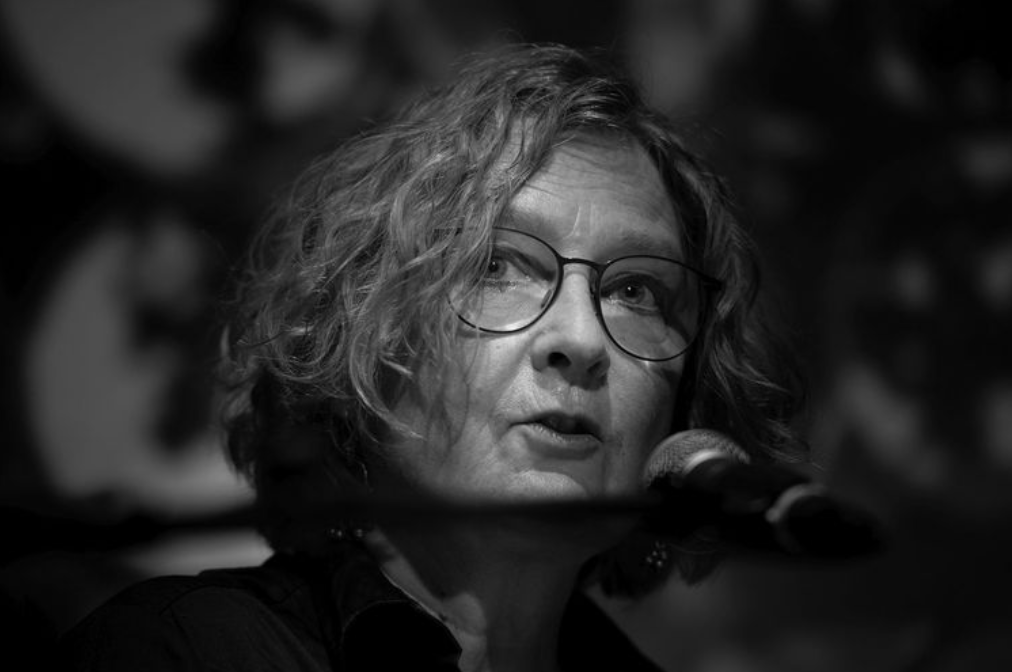
Interview conducted by Thomas Hummitzsch for intellectures, January 31, 2026
Larissa Bender has been translating literature from the Arab world for decades. She was recently awarded the prestigious Sheikh Hamad Prize for her translation of Mustafa Khalifa’s The Shell. These days, the translation of more than two dozen survival testimonies from Gaza, which she worked on together with her colleague Leonie Nückell, is being published. A conversation about the psychological strain of this work, structural racism in the system, and the fascination of Arabic literature.
Larissa Bender, you translate contemporary literature from war-torn regions such as Syria or Sudan, where often the atrocities inflicted on people are depicted. Have you ever had to translate something like Samar Yazbek’s collected survivor testimonies from Gaza before?
No, the accounts of people from Gaza—who were injured, mutilated, and psychologically traumatized and were received in Qatar, where Samar Yazbek interviewed them—are far more harrowing than anything I have translated before. This is probably because the texts are not literarized or heightened; they directly describe what people experienced. When I translated Samar Yazbek’s first documentary on the Syrian revolution in 2011, which detailed the monstrously brutal response of the Syrian regime, I did encounter scenes of extreme cruelty. Translating how, in front of the reporter’s eyes, the brain matter of a shot protester spills onto the street—it takes some processing. Of course, you don’t just brush that off. I remember being almost unable to work for a few days back then. But I had a deadline and had to continue.
With these texts from Gaza, however, the described inhumanity truly left me stunned and at times depressed. Not only because of the brutality, but also because the suffering of the Palestinian civilian population has received virtually no attention in Germany. The hatred toward Arabs—or Palestinians—seems so great that many people have lost all empathy for the Palestinian civilians. Unfortunately, many media outlets have reinforced this; there is enough research on how little the German media reported on this.
You had already translated Samar Yazbek’s novels. Did you still hesitate when you were asked to translate these testimonies?
Yes, absolutely. For one, I wondered who would even read these testimonies. I work as an Arabic translator for a very small audience anyway, but if I feared these texts would be ignored not only for literary but also political reasons, that was even more frustrating. Then I thought that perhaps the time might come when the interviewees’ statements could become relevant. After all, these are their personal truths, and taken together, they convey a fairly accurate picture of what happened in Gaza.
Another reason I hesitated was the fear of being held responsible or attacked as the translator. When we began the translation, the discourse in Germany was completely one-sided against the Palestinians. And often the messenger is held accountable for the message.
You work intensively with the region, the often traumatic experiences, and the usually marginalized positions of Arabic-speaking populations. What particularly struck you in these reports or left a lasting impression?
It was the directness, the unfiltered way in which the interviewees described the brutality they experienced themselves or witnessed firsthand. It really went beyond what I knew from Syrian texts. Anyone who reads the testimonies will understand what I mean.
Can one physically and mentally shield oneself from such horror while translating?
No, you can’t shut it out; that would make you a machine. You have to empathize to a certain extent, imagine what it’s like, what it means not to even be safe in a hospital, to stand amidst the ruins of your house and your entire existence, to have lost your whole family. Moreover, the interviewees were so traumatized that they did not tell their stories chronologically. We often had to try to understand what was meant or ask the author for clarification—whether someone had lost one or both legs, or whether a family lost their third daughter in the first or second bombing. The work on the text was very intense, so I was truly relieved when I read the very last draft and could try to put some distance between myself and it.
In these reports, I repeatedly encountered something shocking that I had previously only read in Atem Abu Saif’s Don’t Look to the Left: Diary of a Genocide. I mean the hybridization of war, the scanning and killing of people from a distance by drones, which also illustrates the enormous imbalance of power. There’s even a specific word for these weapons. How did you feel about this? And how do you explain that it is barely discussed here?
I have been studying the region for almost fifty years, since university, so I have a fairly precise understanding of the situation. What was new for me, however, was a technical detail: iris scanning by drones, which allows Israeli authorities to precisely identify the Palestinian population. That such things are hardly discussed here has to do with Germany’s refusal to face reality. People simply don’t want to know. The reasons are well known. Luckily, in German-speaking countries, we have Arte news, which at least partially informs the public about the situation in Gaza.
You translated the 27 collected eyewitness reports together with your rather young colleague Leonie Nückell. How was that collaboration, and to what extent did you feel the need to protect her from these impressions?
We divided the texts among ourselves and, because the book needed to be published as soon as possible, sent the translations directly to our editor. I didn’t read my colleague’s texts during the working phase, partly for lack of time but also because I was already psychologically absorbed by my own texts. I read the entire book at once only in its collated draft version. During that phase, we clarified many questions together with the editor.
Regarding protecting my colleague: yes, after translating two or three reports, I did wonder whether it was a mistake to ask her to translate the book with me. I questioned whether she could psychologically handle it and offered her the chance to withdraw. But she had already engaged with the texts and was ready to see the project through. Of course, the translation affected her just as much as it did me.
You were just awarded the Sheikh Hamad Prize for your translation of Mustafa Khalifa’s novel The Shell from Arabic. The prize, valued at two million US dollars, is one of the highest-endowed literary awards. The prize money is distributed among several winners. Is it divided equally or is there a fixed sum for each winner?
Yes, there are fixed amounts for first, second, and third prizes in the different categories. However, not all three prizes are necessarily awarded in a category. For example, in translations from German into Arabic, two second prizes and one third prize were awarded. In the opposite direction, only the first prize was awarded this time.
How do you usually get your translation assignments?
As I mentioned, it’s difficult to place Arabic literature with publishers. Most publishers still have too many reservations about Arabic literature. There are various reasons: editors often cannot read the books and rely entirely on the translators’ assessments. Many find this too risky. The books also present readers with entirely new challenges that many are unwilling to engage with. One must understand the literature in its context and not approach it through a literary lens polished by Western standards. For a while, information about the Longlist and Shortlist of the International Prize for Arabic Fiction, established in 2008, still circulated in German media. At that time, translators were frequently asked for evaluations. Once that stopped, interest in Arabic literature in the cultural scene declined again. After the events surrounding Adania Shibli’s novel Minor Detail in 2023 and the Hamas attack on Israel, the situation became even more difficult. There are now pitfalls everywhere that are not easy to avoid.
How is the demand for Arabic literature in German-speaking countries compared to the English-speaking world? And how do you explain the differences?
The demand for Arabic literature here in Germany is very limited. There is a small, dedicated scene of readers who are generally interested in the Arab world, along with a few very knowledgeable literary critics—but there is no broad readership. But how are such books supposed to find a new audience when there is less and less space for book reviews in the media? And when large bookstore chains do not include books from small, unknown publishers in their catalogues? It is precisely the small publishers who champion Arabic literature. In the UK, at least three to four times as much is translated as in Germany, and even in Italy far more translations from Arabic appear each year than in Germany. It is really very frustrating, because we lose access to this large cultural sphere, which is in our immediate neighborhood and from which many people now also live among us.
How large is the geographical area from which you bring us literature?
I mainly translate authors from the Middle East—that is, from Syria, Lebanon, Palestine, and theoretically also Jordan. In these countries, the dialects and ways of life are very similar. Then there’s Iraq and Egypt, but it becomes a bit more challenging there. You can easily fall into a trap, thinking you know a word, only to find that it has a different meaning in that country. It gets even more difficult with literature from the Maghreb—Morocco, Tunisia, Algeria, and also Libya. I have only been to Morocco and Tunisia a few times, and never for long. If you don’t know the daily lives of the people, the political situation, and the local discourses well, it becomes difficult—but not impossible.
In May, your translation of Stella Gaitano’s novel Eddo’s Golden Smile, which is about two women in Sudan, will be published. The South Sudanese author has been living in Germany for three years. How closely did you work with her, and what was that experience like?
I must confess that I had the English translation available. But because Arabic is not as detailed as German and is very open to interpretation, I still had many questions for the author. We had actually planned to meet, since she doesn’t live far away, but for time reasons we had to resolve the questions remotely. For me, the hardest part was really imagining and empathizing with the situation in Sudan. I had once briefly been to Khartoum, but of course that was not enough. I hardly knew how Sudanese people live, what their houses and huts look like, what kind of courtyard they have, the floor surfaces, and many such details. Especially since these questions are also explored in the book, particularly regarding the differences between South and North Sudan. By the way, the novel is set before the country’s division. Thankfully, I received a research grant from the German Translators’ Fund, which allowed me to read many books from and about Sudan and to watch Sudanese films.
If you were to make a case for contemporary Arabic literature, what would you highlight? Why should we all engage more with literature from the Arab world?
For me, literature is the easiest, shortest, and most direct way to encounter the so-called “Other,” to learn about other cultures. Especially today, I think this is more important than ever, because while the world is increasingly interconnected, prejudices are growing rather than shrinking. This is particularly true for the Arab world. Reading literature translated from Arabic is at least an attempt to listen to the other, to try to understand this culture, to open oneself to it, to learn the nuances, and to question one’s own opinions about THE Arabs and THE Muslims. In this area, it’s like football: everyone thinks they know best, even if they’re just sitting on the sofa, and they like to spout clichés on social media in black-and-white terms. Reading also helps us develop empathy for others, which I feel is sorely lacking. There is a very subtle racism toward Arabs in our society that many people don’t even notice in themselves or refuse to acknowledge. I am very confident that reading Arabic literature helps counter this attitude.
Then the suffering of people in Gaza—who have lost everything, who are swept away in their tents during winter storms, who die from a lack of medicine, who have no future and are completely traumatized—would also be more widely recognized.
Fortunately, much has already changed among the German population over the last two years, even if the reporting is still very one-sided. If reporting occurs at all. Currently, the name Gaza is mentioned in public media only in connection with the Trump Riviera Plan. The situation of the population during this particularly harsh winter, however, is hardly mentioned anymore. I am firmly convinced—and this is also what motivates me in my translation work—that people who have read Arabic and Palestinian literature will develop more empathy for Palestinians. Reading Arabic literature—and of course this also applies to literature from other cultural spheres—shows us a way to reconsider the supposed superiority of the West and our own Eurocentrism, which is so deeply rooted in our society. At the very least, it can raise awareness of these issues. Perhaps the Gaza volume by Samar Yazbek, which we translated, can contribute to this. That would certainly be my greatest hope.

