
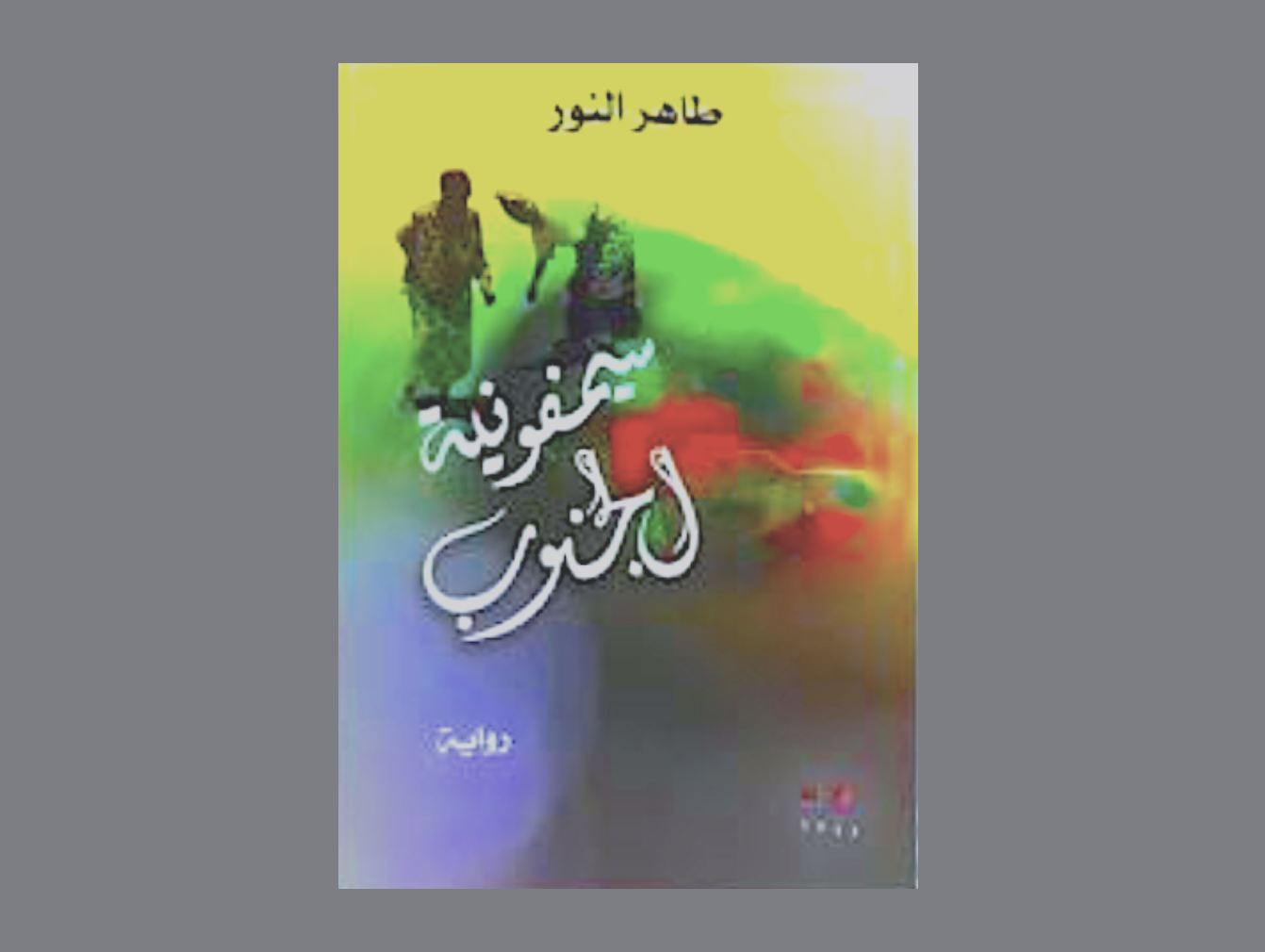
A review by Abdel Kader Dagash for Almohagig, August 10th, 2024
The Egyptian novelist Sonallah Ibrahim once said: “A good historian is a novelist.”
Just as in Samrawit by the Eritrean writer Haji Jaber, we find in Tahir Anour’s Symphony of the South an experience of pain and longing. If we may describe Samrawit as an autobiographical novel in which Haji revealed himself through the character of Omar—something that weakened the narrative structure and turned it into something closer to historical storytelling devoid of suspense—then we may likewise describe Symphony of the South as a personal novel. However, it maintains a distance between the author and his characters, and it is rich in narrative, heritage, and epic spirit. The novel is laden with moral reflections and composed in a coherent and solid storytelling form.
Symphony of the South is wrapped in sorrowful tales. Having a place to belong to is inevitable—dictated by the spherical nature of the Earth and its “flat” world. There must be north and south, west and east, above and below—directions that should coexist in harmony, all pulled toward the Earth’s core, the center of the universe and life—not in opposition. But humans are not only naturally oppositional, they are made so by the destiny of conflict.
While geography may declare all directions equal, history and social norms do not. One’s direction becomes a reflection of identity and value. The novel gives descriptions like:
“…She has all the traits of a true southern girl: strangeness, strength, health, joy, and a magical tone.” (p. 40).
And it draws sharp distinctions:
“This is a real northern boy. People up north are very thin and weak in build… but they are tall.” (p. 41).
The novel approaches religion in its broadest sense—religion as submission to God. Islam here is treated as a universal concept from the first believer to the last messenger, continuing until the Day of Judgment. Yet people’s beliefs differ, even within the same religion. Everyone sees their own perspective as the only truth, and all others as falsehood and loss. Paths may be many, but the destination is one. Taher Al-Noor’s insight emerges through the character Miriam:
“Will my brother Jacob pray with us, or will he go to church with Mama Mandilad when he grows up?”
I asked my father one day, out of sheer curiosity.
He looked at me with kind eyes:
“He will find his own way.”
Even language, meant to convey meaning, becomes a marker of superiority or inferiority—not as a cultural expression shaped by environment and neighboring tongues, but as a tool of social hierarchy. In the south, it’s “Hamed,” and in the north, “Hamid.”
What unites Tahir Anour’s characters are their stories—their “sorrowful lives.” His characters are prisoners of sadness, oppression, and brokenness:
“In the north, it’s not just the land that’s barren; we are barren inside, too. Our pain is real, but we lie about how we express it.”
The narrative repeatedly references women:
“Men here in the south, and even in the north, are ashamed of having daughters. It’s not considered an honor to have only girls. Femininity is weakness and masculinity is strength. That’s what men believe.” (p. 138).
There’s a deeply rooted antagonism toward women, embedded in history and the male subconscious. The author is fully aware of this, and it’s a prominent issue in African societies. One can interpret Taher’s focus on female protagonists (Miriam, Kiyomo, Shinzon, and Dibanti), as well as characters like Mandilad and even Vancia (sister of Lak Tankiyeh, the donkey owner), as a sign of his advocacy for women in a society that disregards their rights.
The stories unfold organically, soaked in sorrow—Hamed, Musa, and Lak Tankiyeh. Lak Tankiyeh says:
“Time swept away everyone I knew, and I was left alone. The donkey owner’s final words echoed in my head like a nail, chaining my domesticated soul. A soft current of moaning surged through me like breathing. I wept, staring at the treetops that rose into the darkness like fallen banners of victory, concealing my grief and the tears now streaming down.” (p. 165).
Memories are harsh, and the past is painfully intense. Yet there is no complete break from it, even if it wounds:
“He who has no past has no future—and I truly believe in that. I cannot live in the present disconnected from the past. I feel my bond with the past is stronger than with the present, and so I must live in harmony between the two eras.” (p. 180).
Many vivid images call for peace, justice, and love—embodying the essence of the novel and the spirit of its stories:
– I am not the North, and you are not the South.
– And what if that’s not true? We do not resemble each other. We share no language, no religion, no race.
– What unites us is stronger than race, language, or religion.
I felt I piqued her curiosity. She turned her whole body toward me. I thought I even saw a shadow of tenderness in her eyes.
– What is it, this thing you believe is stronger than all that?
– The land. (p. 225)
There is no doubt that Symphony of the South is a long novel, but it is beautifully structured and architecturally consistent. It overflows with imagery and similes—perhaps to excess. The writer often uses metaphors in places that don’t necessarily need them. Yet, the reader can’t help but admire the exquisite artistic detail and the careful construction of the novel’s aesthetic world. Miriam narrates about Dibanti during the trial scene:
“I was astonished by the certainty radiating from her—a certainty that embraces cruelty, not pain; that never hesitates, never strays from its path, never contradicts its essence… I didn’t know anymore; I didn’t understand what was happening. Was this Dibanti? The limping Dibanti I’ve known for over five years? The one I loved and who loved me? How much we played together, ran, quarreled, forgave, and shared wonders? I always found her so kind—gentle as a breeze.” (p. 229)
Like all great novels, Symphony of the South is grounded in moral values and profound meaning. Taher presents a purposeful critique of political, ethnic, and religious conflict through his characters with a clean narrative and well-crafted structure—without falling into preachiness. He addresses the issues that have troubled his society, and still do, with honesty—never neglecting history or the causes of conflict, but without turning into a historian. And that is the essence of art.

