
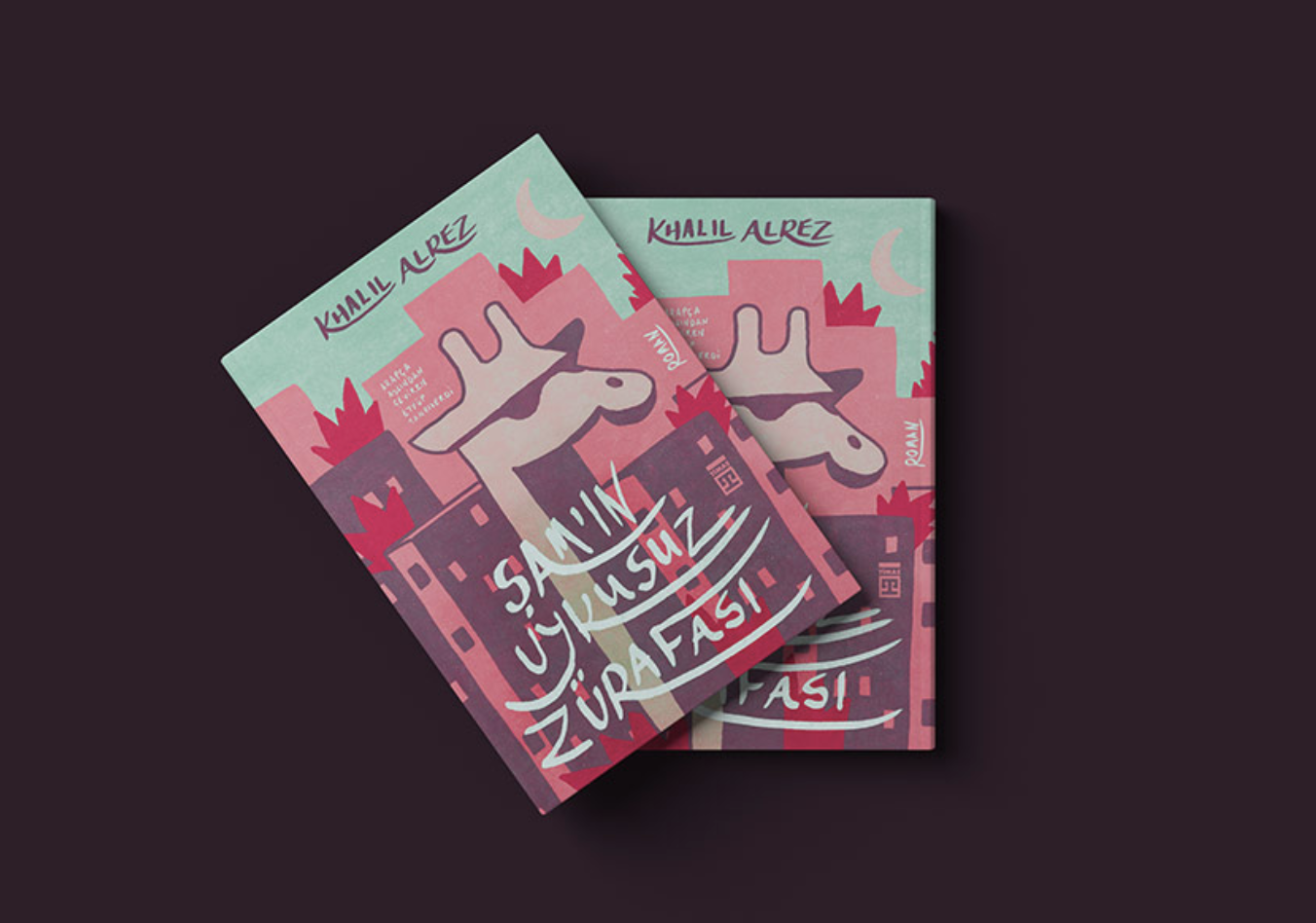
A review by Abdullah Ezik for Artfulliving, June 26th, 2025
Khalil Alrez’s novel The Sleepless Giraffe of Damascus, recently published by Timaş Publishing and translated into Turkish by Eyyüp Tanrıverdi, is an original and impactful work that stands out for both its subject matter and the subtlety with which it handles narrative.
A unique voice in contemporary Arabic literature, Alrez has made a name for himself through novels like Another Day (Youm Akhar, 1995), A White Cloud in the Window of the Grandmother (Gaima Baidaa fi Shubak Al Gadda, 1998), and Where is Safed, Youssef? (Aina Taqaa Al Safad Ya Youssef, 2008). In his writing, he frequently reflects the geography of his upbringing—Syria—and the broader culture of the East, all conveyed through a modern lens. This approach continues in The Sleepless Giraffe of Damascus, resulting in a deeply original text.
This novel can be seen as a narrative of the broader region—namely the Middle East and Mesopotamia—offering a near-contemporary lens into the events and lived experiences of these lands. Set in a war-ravaged zoo in Damascus, it weaves allegory with surreal characters to build a layered narrative. At its center is an unnamed narrator who once worked as a journalist in Moscow and now resides in the Russian Quarter of Damascus, within the zoo. His experiences and reflections build the core of the story, touching on the civil war that devastated Syria. As the narrative unfolds, the intertwined journeys of the Giraffe and Nonna enrich the story even further.
The novel opens with the narrator’s friendship with the Giraffe. He sees her as a confidant, companion, and emotional anchor, shaping his entire life around her presence. Their relationship highlights the essential nature of companionship and illustrates how certain values—such as friendship, loyalty, and resilience—can survive even amidst widespread destruction. Nonna enters the narrative later, bringing along characters like Denis Petrovich, Arkadi Kozmich, and Victor Ivanich, each of whom adds complexity and richness to the novel’s fabric.
The ongoing civil war in Syria is a central theme, constantly present even when not explicitly mentioned. It infiltrates every character’s life, thoughts, and emotions. The narrator frequently reflects on how the war has reshaped not just his own life, but also those of the people around him. One of the modern world’s greatest tragedies, the war finds a deeply personal and literary expression in Alrez’s novel.
Blending fiction and reality, the story exists in a liminal space—neither fully real nor entirely imaginary. Both the zoo and the Russian Quarter serve as symbolic settings that reflect deeper truths rather than literal geography. What matters more than plot or character is the emotional and psychological devastation brought by war. Alrez’s choice of setting underscores this theme, locating the story in a place that, though not entirely real, encapsulates the universal impact of trauma.
In a world where everyone is trying to survive and find refuge, the zoo becomes a metaphor for both a miniature state and a place of escape. The narrator, the Giraffe, and Nonna each attempt to build a new life within this autonomous space. They form bonds, fight inner and outer battles, and navigate an ecosystem of layered allegiances. Characters like Victor Ivanich, a zoo director; Abu Ali Suleiman, a French teacher and shopkeeper; Issam, the neighborhood hero; and Arkadi Kozmich, a Russian writer, all embody different facets of survival, nostalgia, authority, and hope.
Memory—both individual and collective—is another major theme. The Giraffe’s fear of lions and Nonna’s suppressed anxieties reflect the silent, yet pervasive presence of trauma. Fear is something shared by all characters, though few can voice it. Here, collective memory becomes a unifying force, offering a shared emotional language through which the characters find common ground. Despite their diverse backgrounds, they move together in a shared emotional direction.
Perception and reception also play key roles in the novel. The Giraffe’s blindness serves as a metaphor for how meaning is shaped by the observer. While Victor Ivanich sees her as useless, the narrator and Nonna view her as insightful and deeply meaningful. This contrast illustrates how value and interpretation vary from person to person, a theme that resonates throughout the story.
Ultimately, The Sleepless Giraffe of Damascus is a richly layered novel shaped by a historic catastrophe. Intertwining fiction with lived reality, and grounded in characters like the narrator, the Giraffe, and Nonna, it offers readers a deeply textured, compelling narrative from one of Arabic literature’s most distinctive voices.

