
A review by Wafaa Sha’rani, for Alaraby, April 16th, 2025
Photo credit: Akram Zaatari (Lebanese, b. 1966)
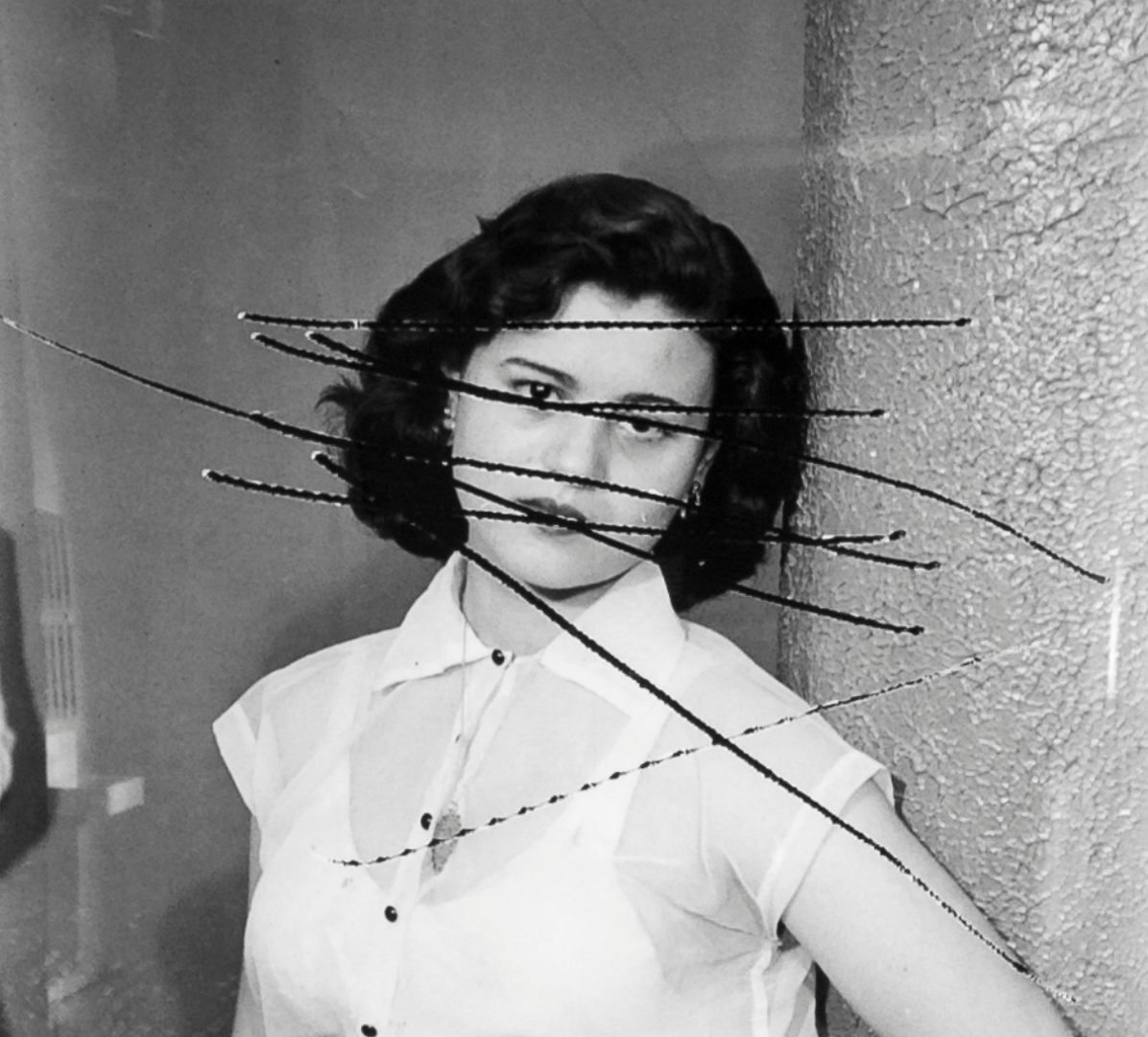
Damaged Negatives: Scratched Portraits of Mrs. Baqari
2012
Made from 35mm scratched negative from the Hashem el Madani archive
Installation view, Akram Zaatari: The Fold – Space, time and the image
© Contemporary Arts Center, Cincinnati, OH, 2018
I don’t know to what extent the structure of the novel May Vanishes can be explained, or how far one can delve into the idea of the self as presented by Najwa Barakat. It is far more than a fleeting or simple concept—there are uses that branch out and diversify across the first two parts, “May” and “She,” leading into a state of overwhelming estrangement and alienation at the core. In the third part, “Youssef,” the novel takes a different turn toward a complete transformation.
We are dealing with a novel that demands introspective vision and deep contemplation. It must be approached from an intellectual level, grounded in the relationship between the “I” and the self, between “May” and “She.” The material is difficult, as it requires the “I” to form a theory about a self that is inherently a part of it. Between “May” and “She,” there is a state of alienation and estrangement. “May” remains a lost particle among other particles, never creating her spirit within another, as the Hegelian system proposes. The novel’s war zones also expand, with Beirut exposed and abandoned. And when the external world is no longer an extension of the self, the individual is left with nothing but withdrawal—this is where the concept of alienation earns its place in a novel like this: a unique novel, a vessel cutting through turbulent waves.
Alienation is the spirit of protest, a critique of humanity in defense of faith, and then a defense of the usurped human essence. It bears the shadows of negation and destruction. Negativity becomes withdrawal and regression. In May’s case, it served the most disparate, varied, and contradictory phenomena in her consciousness—when the reclusive eighty-year-old woman is suddenly haunted by a woman’s voice calling her insistently. She begins to monitor it with precision, caution, and terror. She seeks help from the building doorman, Youssef, who reassures her, “There’s no one in the house, Miss May.” Youssef knows every detail of the apartment, perched on the ninth floor overlooking Beirut. He’s been assigned to care for May while her twin sons live in the United States. After confronting the woman behind the voice, May becomes convinced she belongs to the past. But what past? “The past,” she says, “is a gaping black hole, pulling and sucking with the force of a magnet—until it swallows everything.”
Inside the apartment and from the balcony, May has trained herself to live indifferently—without emotions like sadness, anger, or even love. From the ninth floor, she watches the miserable, desperate people leaving for work at dawn—fleeing one misery only to meet another. Beirut, with its wealth of stories, accumulates tragedies. May is haunted by phobias—of thieves, the sea, tsunamis, and the port explosion. In the “master–slave dialectic,” there is an affirmation that self-consciousness can only be achieved through the recognition of the other, because the self is a complex psychological and social system. Henry Miller, in Reflections of the Eighties, asks: “Can a person truly know themselves completely?” It’s a mystery that remains closed.
“Beirut, with its wealth of stories, accumulates tragedies. May is haunted by phobias—of thieves, the sea, tsunamis, and the port explosion.”
When I claim that the novel’s entire theoretical foundation lies in the relationship between the first two parts, “May” and “She,” in the limbo of selfhood and alienation, I mean that the narrative successfully captures this complex relationship through meanings and symbols. May’s self represents the individual and the collective, and her relationship with men—experiencing love, then a cold marriage, followed by a family and two sons who disappear for a long time—builds this. Her narrative is astonishing. Her absence is an absence of shock and disappointment, an absence of transition to another place. Through Barakat’s stream-of-consciousness narration, the dynamics of hidden desires in the unconscious begin to surface, revealed in “She” in the second part. It unveils the power of Eros, the force that had drawn May toward a being with whom she sought to unite in a transcendent bond that promised continuity and fulfillment—an ultimate spiritual desire for freedom and awareness.
That force collapsed in love—both in its sexual and social forms. Even relocating to far-off Amchit couldn’t restore love as a life-affirming force. Nor was motherhood an accessible path of fulfillment. The drive never reached satisfaction, and thus May’s pure spiritual domain became the domain of creation. There, her spirit took its final step toward freedom. May loved theater. She excelled at it. She acted, wrote plays—including one for him. Her spiritual creativity was her first gateway. But she was forced into disappointment, confronting a deadly destructive force. She resorted to the crudest form of response to the shattering of transcendence: she sculpted in stone while the war’s shadows loomed over Beirut’s darkened streets. The narrative wasn’t focused on action—it transcended action into margins, the home of repressed and broken desire.
Morning crept in as I read Najwa Barakat’s May Vanishes, listening to the disciplined, mobile, intersecting, and shifting narration, showing me May’s face through its constant transformations and methods of self-perception. It is “She”—the process of realization becomes an internal engine. The parts “May” and “She” form a foundation for the concept of the self—of a human being split into two: the unconscious and the conscious. But this split does not constitute separation as much as it represents an interrelation—a chain of signifiers upon which the narrator, using the first-person voice, builds her structure. The narrative moves between the anticipation of death and wit, between location and time, between May’s routines—her coffee, herbs, insomnia, the doorman, the cat, and Chamili, the Sri Lankan woman. The narration flows metaphorically and figuratively, expressing the self.
May’s movements between her living room, balcony, and kitchen, and her speech about a severed past, form a surface structure that veils a deeper language: the language of love as she experienced it in youth. Barakat leads the reader into vast fields of love: days spent with a lover turn into a battle against a destructive impulse capable of leading to murder. Was May’s fear rooted in her desire for the self? Did she delude herself into believing she could transcend her limits, driven by an old narcissism from a psychological reality that taught her to reject commitment to the outside world?
In the third part, Youssef the doorman will rent or sell the apartment, following the request of the ever-absent twin sons. He alone continues to monitor May’s breath and movement. He came from Aleppo’s outskirts fleeing war. “I don’t know,” he says, “who’s worse off—us Syrians, the Lebanese, or Chamili?” The apartment becomes the immediate space for resurrecting May’s past. Youssef emerges as a distinctive human presence, experiencing a genuine human connection with May. His feelings toward her are spontaneous and sincere. He gathers various elements that allow the reconstruction of consciousness, the recollection of past events, and control over previously repressed emotions. The third part becomes a space of reconciliation—a complete transformation of a state of conflict that had weighed heavily on the fate of coexistence and culture among citizens, migrants, refugees, and workers. Youssef reassembles the elements of these relationships anew.
Henry Miller writes in Reflections of the Eighties: “The final veil should never be torn, for when we lift the last veil, we see the void. The most terrifying idea is to see and think within the void. Perhaps everything around us—except for love—is nothing. And that is madness. All that lies above the ground is dust. And I am the drowning man, so what fear have I of getting wet?”
In this novel, love carries the revelation of beauty in meaning—as the meaning of goodness and truth. Human beings only truly deserve existence if they are great lovers.

