
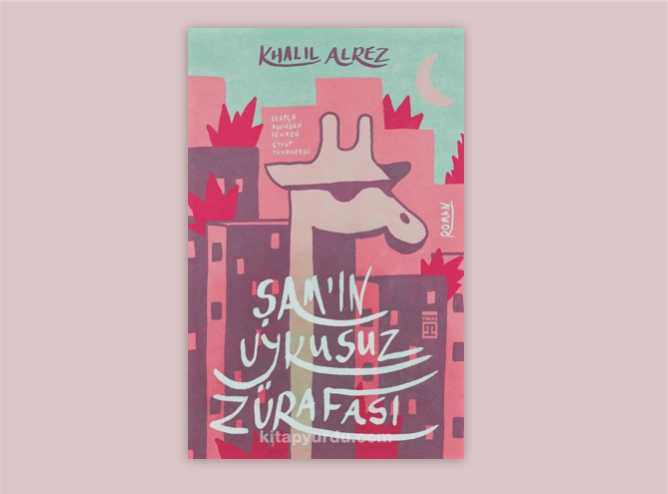
A review for Oggito by Adalet Çavdar, April 23, 2025
Alrez’s pen creates a fairytale-like reality; while blending truth and fantasy through the giraffe’s prophecies, it lightens the weight of war with subtle irony.
For the past month, the state of the country is well known. We do nothing but express our democratic demands, yet in return, we find nothing but silence and indifference. Each morning we wake up with new tension, only to end the day with fresh disappointment. Our streets and cities are not closing in on themselves; rather, they are being closed in. As the spaces where our voices can echo become narrower, our anger grows. It is in times like these that opening a book, finding a companion for my anger among the pages, and taking a breath feels essential. Khalil Al Rez’s A Sleepless Giraffe in Damascus is a novel of resisting through stories, dreams, and tales in the very heart of war. I finished it a few days ago, and it still quietly speaks within me. Along with the book, I ask myself: If a person can find hope even in the midst of war, how can we fail to keep hope alive while demanding our democratic rights in our own land? Must we always pay a high price to resist, or are our stories sometimes enough?…
The Plot and Setting
A Sleepless Giraffe in Damascus takes place in a fictional Russian neighborhood in the eastern part of Damascus, under the destruction of the Syrian Civil War. This neighborhood becomes a refuge for a handful of people trying to remain neutral and their animal companions. The novel begins with the distant rumble of war; bombs falling on Ghouta shake the neighborhood walls. The residents cling to the hope that “nothing will happen to us” and try to carry on with daily life. Al Rez paints this false calm so masterfully that while you feel the neighborhood’s liveliness, the shadow of impending doom is ever-present.
The story unfolds through the eyes of a young translator living on the roof of the local zoo—our unnamed narrator. His close friend Nonna adds color to the neighborhood with her knitting; and then there’s the long-necked giraffe, quietly watching over the neighborhood every evening while eating green onions. The neighborhood feels like an oasis untouched by war. Abu Ali Suleiman teaches French to students, Victor Ivanich feeds the animals, and Rashida enlivens the cabaret with her oud. But this vitality is an illusion. The sounds of explosions from Ghouta slowly erode the peace.
The Onset of War and Symbolism
Eventually, war begins to seep into the neighborhood. One day, a nearby explosion shakes everyone; soon after, a rocket lands at the neighborhood’s edge. Isam, the brave young man of the area, loses his life in the chaos. It becomes clear that war is at their doorstep, and silence is no longer an option. Nonna and the narrator start spending more time with the giraffe, who grows increasingly restless—like a wise creature sensing the approaching tragedy. Despite their fears, the residents resist through storytelling. Everyone shares their own tale; these stories become a shield against the horrors of war.
Realizing that silence is not enough, the residents decide on a peaceful march. The giraffe leads the way, followed by Nonna, the narrator, Victor, Rashida, and others, heading toward Umayyad Square in the heart of Damascus. But they are met with tragedy: the giraffe, a symbol of innocence, is shot and killed in front of everyone. Nonna’s tears, the narrator’s helplessness, the cries of the neighborhood… The novel ends as the narrator records this memory; the fate of the neighborhood remains uncertain, but their stories continue to live….
Literary Reception and Impact
A Sleepless Giraffe in Damascus was an IPAF finalist in 2020 and received international acclaim. Al Rez tells the story of the Syrian Civil War and the bombings of Ghouta through the eyes of ordinary people. But he avoids grand declarations, instead highlighting the absurdity of war and the ease with which innocence is destroyed—while gently whispering that resistance through stories is still possible.
Al Rez’s pen creates a magical realism; the giraffe’s prophetic unease blends reality and dream, softening the heaviness of war with subtle wit. For example, the scenes where the giraffe senses approaching disaster through its anxious behavior create a magical atmosphere while also evoking the inevitability of war…

